Sunday, December 30, 2012

The Holy Family: Fr. Andersen's Homily

A Homily by Fr. Eric M. Andersen, Sacred Heart-St. Louis in Gervais, OR

December 30, 2012 Sunday in the Octave of Christmas: The Holy Family

A little over a week ago, our Holy Father Pope Benedict XVI gave his annual pre-Christmas address to the Roman Curia (Dec 21st, 2012). In his talk, he said that the family is in crisis not only because of a false understanding of freedom, but from a defective belief in what it means to be human. This is where we must begin. What does it mean to be human? This is probably one of the most important questions being debated today. He cites Gilles Bernheim, the Chief Rabbi of Paris, France who has raised awareness against a philosophical shift which has replaced the distinguishing word ‘sex’ to identify either male or female, with the word ‘gender’. There are consequences for this change of verbiage.

He begins by recalling a quote from Simone de Beauvoir who said: “ ‘one is not born a woman, one becomes so.’ We can easily be drawn to this quote because it is witty, it is romantic, and it shows a sense of confidence. But it betrays a shallow knowledge of what it means to be human. “These words lay the foundation for what is put forward today under the term ‘gender’ as a new philosophy of sexuality. According to this philosophy, sex is no longer a given element of nature, that man has to accept and personally make sense of: it is a social role that we choose for ourselves, while in the past it was chosen for us by society” (Benedict XVI). The Holy Father is referring here to a denial of the basic anthropology of man.

The Ecumenical Council of Vienne in the year of our Lord 1312 defined and decreed that the substance of the rational and intellectual soul is the form of the human body (cf. Denzinger, 902; Council of Vienne, Constitution Fidei catholicae). The soul is the form of the human body. Why was it necessary to define such a thing? Because in the previous century, a certain Franciscan by the name of Peter John Olieu, OFM, had proposed otherwise. So you see, there are no new ideas. There are no new heresies. Every heresy that arises in our day is just the revision of an old one. What was false then is false now. What is true is always true. The soul is the form of the human body.

Our Holy Father has cited a new philosophy of gender in which certain people believe that “sex is no longer a given element of nature, that man has to accept and personally make sense of” but rather they believe that “it is a social role that we choose for ourselves, while in the past it was chosen for us by society” (Benedict XVI). Our Holy Father comments:

“The profound falsehood of this theory and of the anthropological revolution contained within it is obvious. People dispute the idea that they have a nature, given by their bodily identity, that serves as a defining element of the human being. They deny their nature and decide that it is not something previously given to them, but that they make it for themselves” (Benedict XVI).

You see, the Holy Father is referring to the fact that our nature is decided for us by our physical bodies. If my physical body is male, then my nature is male. That means that my soul is male because, remember, the soul is the form of the body. My physical body determines my soul. There is no such thing as being a woman trapped in a man’s body. There is no such thing as a neuter soul. There is no such thing as an androgynous soul. My soul will be male after my body dies and my male soul will await the reunion of my male body at the General Resurrection and Last Judgment. This is because the soul and body are so intimately united that they cannot be separated. My soul will never belong to another body. The body I will receive at the Resurrection will be the same body I have now, albeit perfected and glorified. So, the nature of my soul is not up to me to decide. It is given to me by God. It is a fact. It is who I am physically and therefore who I am.

The Holy Father continues:

“According to the biblical creation account, being created by God as male and female pertains to the essence of the human creature. This duality is an essential aspect of what being human is all about, as ordained by God. This very duality as something previously given is what is now disputed. The words of the creation account: “male and female he created them” (Gen 1:27) no longer apply. No, what applies now is this: it was not God who created them male and female – hitherto society did this, now we decide for ourselves. Man and woman as created realities, as the nature of the human being, no longer exist. Man calls his nature into question. From now on he is merely spirit and will” (Benedict XVI).
 
This brings us back around to the family. A family is defined as husband and wife and children. A husband is a man and a wife is a woman united in the sacrament of Matrimony. Through the sacramental act between husband and wife God may grant children to that marriage and a family grows out of that. This is defined by God. It is not a social construct, nor can it be changed even if one rejects society or changes society. But this is a bigger issue than society. It is about God and it is about the identity of being human. Our Holy Father continues:

“Man and woman in their created state as complementary versions of what it means to be human are disputed. But if there is no pre-ordained duality of man and woman in creation, then neither is the family any longer a reality established by creation. Likewise, the child has lost the place he had occupied hitherto and the dignity pertaining to him. Bernheim shows that now, perforce, from being a subject of rights, the child has become an object to which people have a right and which they have a right to obtain” (Benedict XVI).

It is a subject of great sorrow when a husband and wife cannot conceive and bear children. But that also is decided by God and we cannot treat the child as an object which people have a right to obtain by any means.

Our Holy Father concludes on this topic:

"When the freedom to be creative becomes the freedom to create oneself, then necessarily the Maker himself is denied and ultimately man too is stripped of his dignity as a creature of God, as the image of God at the core of his being. The defence of the family is about man himself. And it becomes clear that when God is denied, human dignity also disappears. Whoever defends God is defending man" (Benedict XVI).

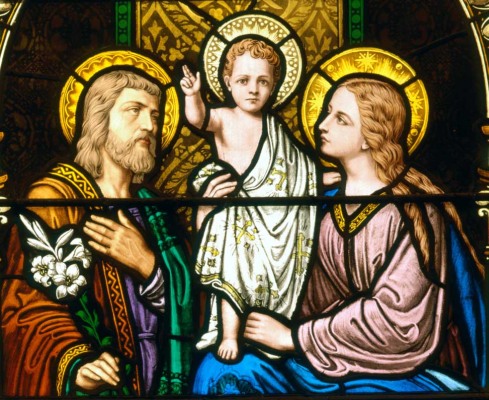
On this feast of the Holy Family, I wanted to share with you these words of Pope Benedict. It is important today as Catholics that we are literate. I want to encourage every person in this room to read something this year written by Pope Benedict XVI. Here he is writing on something important about family life. The family is defined and created by God for us. At Christmas we can look at the beauty of the Holy Family: Joseph and Mary and the Holy Child Jesus. They are an example to us of what family life looks like.

As Catholics we are called to defend authentic family life. We must understand authentic family life in order to defend it. Our Holy Father’s address to the Roman Curia helps us to understand some of the issues being disputed today. During this Year of Faith, let us resolve to become literate Catholics and grow in our faith. We need to be reading our Bibles and reading the Catechism of the Catholic Church. Let us do so as families for ages upon ages have done. St. Joseph certainly read to his family from the Holy Scriptures and from the teachings of the Rabbis. Fathers today are called to imitate St. Joseph as the spiritual heads of their families. Fathers: read to your families at the dinner table. Read to them out loud each night a chapter from the Holy Scriptures and a section from the Catechism. By doing so, you will set a good example for your children and you will show your love for God and your love to your family as a provider of God’s loving words, a protector of their souls, and a teacher of divine wisdom for a blessed life. 

Friday, December 28, 2012

The Feast of the Holy Innocents

Below are lessons 4, 5, and 6 from the Divine Office of Vigils (Matins) for the feast of the Holy Innocents. One aspect that strikes me is that there is an emphasis on the fact that Heaven is our homeland.

Even if we suffer severely here on earth, it is only temporal suffering. It will end. It may seem unbearable in our immediate experience, and indeed, we may die of it, as have countless martyrs through the centuries. And yet, it will end. Eternity lies beyond that end, and we have the hope of spending that eternity in Heaven, with all the saints, adoring and praising God endlessly.

I think that’s one of the things we forget when we suffer ourselves, or when we read of others’ sufferings (as in the children of Newtown, who must of course come to mind today).

Here are the lessons, combined:

From the Sermons of St Augustine, Bishop of Hippo. 10th on the Saints.
 
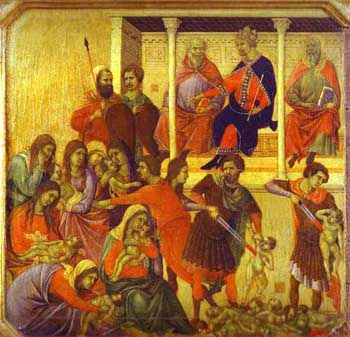
Dearly beloved brethren, to-day we keep the birthday of those children, who, as we are informed by the Gospel, were massacred by the savage King Herod. Therefore let earth rejoice with exceeding joy, for she is the mother of these heavenly soldiers, and of this numerous host. The love of the vile Herod could never have crowned these blessed ones as hath his hatred. For the Church testifieth by this holy solemnity, that whereas iniquity did specially abound against these little saints, so much the more were heavenly blessings poured out upon them.

Blessed art thou, O Bethlehem in the land of Judah, which hast suffered the cruelty of King Herod in the slaughter of thy children; who art found worthy to offer at once to God a whole white-robed army of guileless martyrs! Surely, it is well to keep their birthday, even that blessed birthday which gave them from earth to heaven, more blessed than the day that brought them out of their mother's womb. Scarcely had they entered on the life that now is, when they obtained that glorious life which is to come.

We praise the death of other martyrs because it was the crowning act of an undaunted and persistent testimony; but these were crowned at once. He That maketh an end to this present life, gave to them at its very gates that eternal blessedness which we hope for at its close. They whom the wickedness of Herod tore from their mothers' breasts are rightfully called the flowers of martyrdom; hardly had these buds of the Church shown their heads above the soil, in the winter of unbelief, when the frost of persecution nipped them.

And here is the hymn for Morning Prayer for today’s feast. I found it very touching!

ALL hail, ye little Martyr flowers,
Sweet rosebuds cut in dawning hours!
When Herod sought the Christ to find
Ye fell as bloom before the wind.

First victims of the Martyr bands,
With crowns and palms in tender hands,
Around the very altar, gay
And innocent, ye seem to play.

All honor, laud, and glory be,
O Jesu, Virgin-born to thee;
All glory, as is ever meet
To Father and to Paraclete.
Amen.


Thursday, December 27, 2012

Fr. Andersen: Homily on St. John the Apostle

A homily by Fr. Eric M. Andersen, Sacred Heart in Gervais, Oregon

December 27th, 2012 St. John the Evangelist, Apostle

 
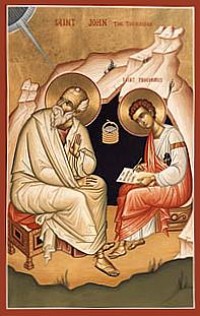
It is said that the greatest sacrifice of love to God is martyrdom, but second to that is the sacrifice of virginity. Our saint today is called the beloved disciple. He is one who followed the Lamb wherever He went. But God did not demand his blood from him in martyrdom. St.   John lived out the white martyrdom, offering to God his virginity.  

Tradition tells us that St. John left “not only his father Zebedee, but even his betrothed, when everything was prepared for the marriage” (Gueranger, The Liturgical Year, Vol. 2, pg. 250).

The Old Roman Ritual contains in it two blessings of wine on the feast of St. John. This wine is blessed at the end of the Mass after the Last Gospel is read and is then to be drunk at dinner on the feast. The story comes to us that in Ephesus, St. John preached the Gospel and “idol-worshippers stirred up a riot among the populace, and they dragged him to the temple of Diana and tried to force him to offer sacrifice to the goddess. Then the saint proposed this alternative: if by invoking Diana they overturned the church of Christ, he would offer sacrifice to the idols; but if by invoking Christ he destroyed Diana’s temple, they would believe in Christ. To this proposal the greater number of the people gave their consent. When all had gone out of the building, the apostle prayed, the temple collapsed to the ground, and the statue of Diana was reduced to dust.”

In response, the high priest Aristodemus incited the people against the apostle. He then challenged St. John, saying: “If you want me to believe in your God, I will give you poison to drink. If it does you no harm, it will be clear that your master is the true God.” St. John consented. But first Aristodemus had two condemned criminals released from prison and, in the presence of the crowd, gave them the poison to drink so that St. John would have to watch them die and it would fill him with a greater fear for his own life. “Then the apostle took the cup, armed himself with the sign of the cross, drained the drink, and suffered no harm, and all present began to praise God” (Voragine, The Golden Legend. Vol. I., p. 53).
 
“St. Clement relates. . . that the blessed John once converted a handsome but headstrong young man and commended him as a ‘deposit’ to a certain bishop. Some time later, however, the young man left the bishop and became the leader of a band of robbers. Eventually the apostle came back to the bishop and asked him to return his deposit. The bishop, thinking that he was talking about money, was taken aback, but the apostle explained that he meant the young man whom he had so solicitously entrusted to his care. The bishop answered: ‘O my venerable father, that man is dead, spiritually at least; he lives on yonder mountain with a band of thieves and has become their chief.’ At that the saint tore his mantle, beat himself about the head with his fists, and cried: ‘A fine guardian you have been for the soul of a brother whom I left with you!’

“Quickly he ordered a horse saddled, and rode fearlessly toward the mountain. The young man, seeing him coming, was overwhelmed with shame, mounted his horse and rode off at top speed. The apostle, forgetting his age, put spurs to his mount and chased the fugitive, calling after him: ‘What, my beloved son! Do you flee from your father, an old man, unarmed? My son, you have nothing to fear! I shall account for you to Christ, and be sure I will gladly die for you, as Christ died for all of us. Come back, my son, come back! The Lord himself has sent me after you!’ Hearing this, the young man, filled with remorse, turned back and wept bitterly. The apostle knelt at his feet and, as though repentance had already cleansed it, began to kiss his hand. Then he fasted and prayed for the penitent, obtained God’s pardon for him, and later ordained him a bishop” (Voragine, 53-54).

“According to St. Jerome, Saint John stayed on in Ephesus into his extreme old age. He grew so feeble that he had to be supported by his disciples on his way to the church and was hardly able to speak. At every pause, however, he repeated the same words: ‘My sons, love one another!’ One day the brethren, wondering at this, asked him: ‘Master, why are you always saying the same thing? The saint replied: ‘Because it is the commandment of the Lord, and if this alone is obeyed, it is enough’” (54-55). 

Tuesday, December 25, 2012

Homily for Christmas Day: Fr. Andersen


A homily by Fr. Eric M. Andersen, Sacred Heart-St. Louis in Gervais, Oregon
December 25th, 2012 In Nativitatis Domini

“In the forty-second year of the reign of Caesar Octavian Augustus,  the whole world being at peace…”

On the Ides of March, in the year 44 BC, Julius Caesar was murdered. His grand-nephew and principal heir, Octavian, came to Rome to claim his inheritance. The young Octavian allied himself with Marc Antony to secure the Roman Empire and take revenge on Brutus and Cassius, the murderers of his uncle. Octavian obtained great victories in battle and won his troops over to his side securing himself the title of Pontifex Maximus in Rome.

The vast Roman Empire was then split between Marc Antony in the East and Octavian in the West. Marc Antony married the sister of Octavian, but the marriage was not to last. He soon put away his wife having become infatuated with a woman named Cleopatra who brought about his downfall. Octavian declared war against Cleopatra and, upon his victory, Marc Antony and Cleopatra both committed suicide. Octavian ended up with the entire Empire at his command––East and West.

“In the year 27 B.C., three years after his assumption of office, the Roman Senate had already awarded him the title Augustus…meaning ‘one worthy of adoration.’” (Benedict XVI, Jesus of Nazareth: the Infancy Narratives, p. 60). He was hailed as Saviour and Redeemer (cf. 60) because he ushered in the Pax Romana, or Roman Peace. This was an era of so-called “universal peace” that lasted for about 207 years. It was a time of great prosperity in the vast Roman Empire. Caesar Octavian Augustus “was a patron of art, letters, and science, and devoted large sums of money to the embellishment and enlargement of Rome. It was his well-known boast that he ‘found it of brick and left it of marble.’” (Healy, “Augustus”, The Catholic Encyclopedia. Vol. II. 1913. p. 107).

During this time, “the Romans built a Temple of Peace and placed a statue of Romulus in it.” The Roman god Apollo was invoked for an oracle and asked how long the temple would stand, and the answer was that it would be until a virgin bore a child. Hearing this, the people said that the temple was eternal, for they thought it impossible that such a thing could happen; and an inscription TEMPLUM PACIS AETERNUM, was carved over the doors” ( Voragine,  The Golden Legend, Vol. I, p. 37).

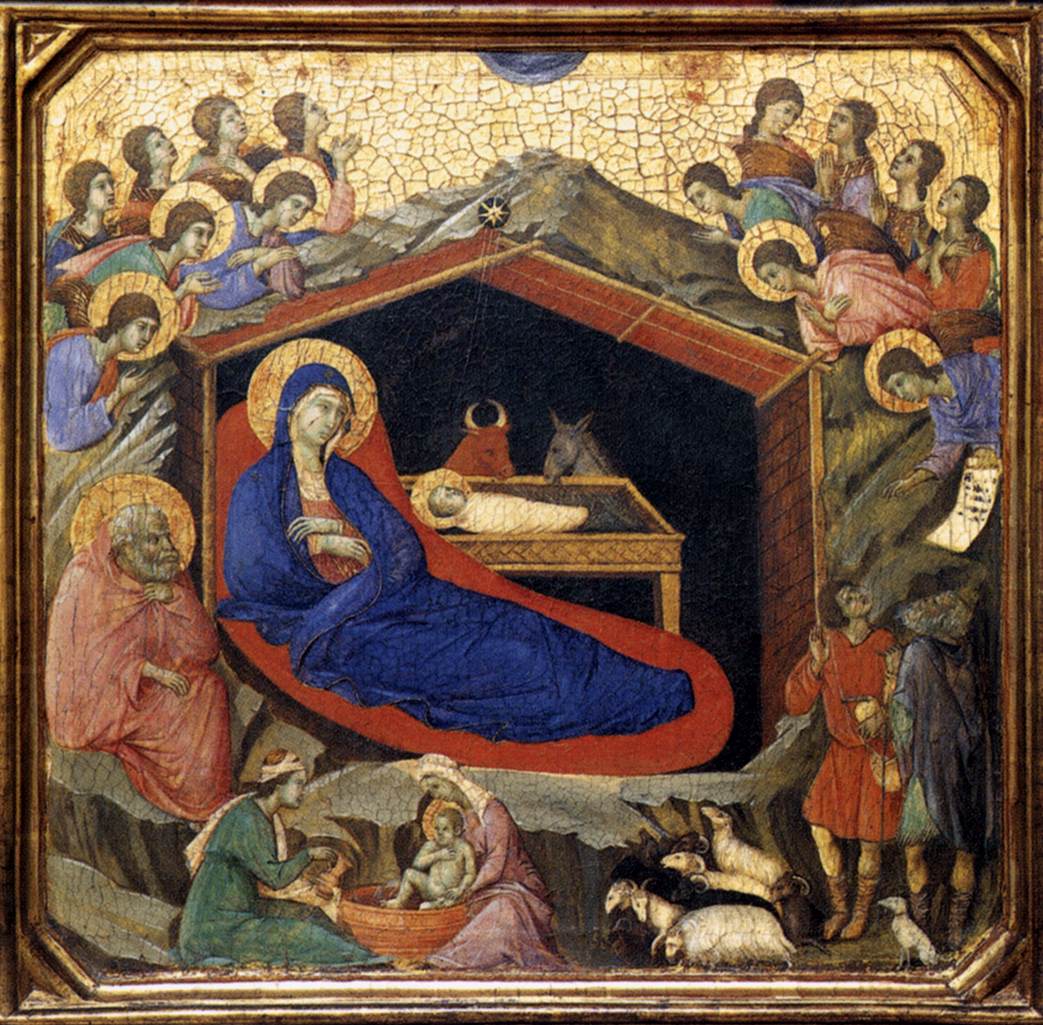
And then, “In the forty-second year of the reign of Caesar Octavian Augustus, the whole world being at peace, JESUS CHRIST, eternal God and Son of the Eternal Father, …was born of the Virgin Mary in Bethlehem of Judah, and was made man” (Roman Martyrology for December 25th. Roman Missal. 3rd Ed. Appendix I). On that “very night when Mary bore Christ, the temple crumbled to the ground”(Voragine, 37). The Temple of Peace Forever, which crumbled on the day of Christ’s birth, was replaced by the Church of Santa Maria Nuova which stands upon that very site today.

So who is the true Prince of Peace? At that time, the world claimed it to be Caesar Octavian Augustus. He was hailed as a Savior. But the Pax Romana was only a relative peace. “Romans regarded peace not as an absence of war, but the rare situation that existed when all opponents had been beaten down and lost the ability to resist” (Wikipedia, “Pax Romana”). So the Roman Peace was maintained by worldly means and by force.

But true peace cannot be obtained by man. The United Nations will never achieve world peace because peace cannot be regulated. It must first dwell in the heart of every man. The United Nations cannot bestow that gift. In fact, peace is not a gift at all. It is a fruit of the Holy Spirit. Peace requires man’s cooperation, but it does not originate from man, nor can man achieve such a thing. True peace can only come from God. Jesus Christ is the Prince of Peace. He sends His Holy Spirit to fill us with His gifts. Peace then is a fruit which is borne from one cultivating the gifts of the Holy Spirit.

Peace “is the tranquility which follows upon joy arising from charity” (Ripperger, Introduction to the Science of Mental Health. p. 422). “When one’s heart is made perfectly peaceful in one thing…he is not able to be…disturbed, for he thinks of other things as nothing. As a result, as one’s heart comes to rest in God alone through charity, then peace arises as the …fruit of the Holy Spirit of peace” (422). St. Augustine defined peace “as the tranquility of order. When various parts within a society or a person are rightly ordered among themselves, then tranquility arises” (footnote 38, p. 422).

Contrary to peace is idolatry: “Anything which goes contrary to the teachings of revelation, resulting in man committing idolatry by having something other than God as his good, goes contrary to peace” (422). This is why the Fathers of the Church stressed detachment from worldly things and love for God alone. St. Augustine taught that one should use and enjoy those things of creation that God has given, but one should not love such created things. One should love God alone above all things. This protects one from idolatry.

Peace in itself became an idol to the Romans during the time of the Pax Romana. They wanted to achieve peace at all costs. It was preserved by means of might, and therefore it was not true peace. True peace is not obtained overnight, even by the most fervent of souls. The spiritual life is a lifelong commitment. If we cooperate with God, we grow ever so gradually towards perfect union with Him. Peace is a fruit which means that it must be ripe before it can be enjoyed. The soul must be cared for, watered, fertilized, and pruned. Fruit comes at harvest time. We cannot be in too much of a hurry to harvest, or else we may end up with unripe and bitter fruit.

Jesus Christ, the Prince of Peace, has come to us in such a gentle way at Christmas, as a baby. He is so lovable. We can approach Him as a baby and immediately feel His peace. This Christmas let us put away any idols that have crept into our lives, especially the idol which promises a false peace at any cost. Let us demolish the false Temple of Peace Forever in our own lives in favor of the true God who gives us real peace in our souls. In other words, let us clean up our lives, put things in order, live by the laws of Christian morality, make holy the Lord’s day every Sunday, and give true worship to Jesus Christ, true God and true Man, here in this Temple of God. Let us pray that our bodies will be worthy temples of God, with the indwelling of the Holy Spirit and that be cultivating that gift, we may bear the ripe fruit of peace in our souls forever.

Sunday, December 23, 2012

Fr. Andersen's Homily for the 4th Sunday of Advent


A homily by Fr. Eric M. Andersen, Sacred Heart-St. Louis in Gervais, OR

December 23rd, 2012 Dominica IV Adventus, Anno C


Roráte caeli, désuper, et nubes pluant iustum. . .

“Drop down dew from above, you heavens, and let the clouds rain down the Just One; let the earth be opened and bring forth a Savior” (cf. Isaiah 45:8).

The prophet Isaiah greets us in today’s Entrance Antiphon and helps us to prepare for Christmas. Dr. Pius Parsch writes that “(Isaiah’s) cry must become our own. Before God comes to us, He demands preparation. He will not force His gifts upon us. We must desire them, we must be spiritually hungry.” Parsch makes this great statement: “Advent desire means that we must cultivate a fruitful soil for the seed of grace, that we become receptive to God’s kingdom” (The Church’s Year of Grace, Vol. I: Advent to Candlemas, p. 134). This applies directly to these words from the prophet Isaiah: “Drop down dew from above, you heavens, and let the clouds rain down the Just One; let the earth be opened and bring forth a Savior.” This prophecy of Isaiah is fulfilled with the coming of the Divine Child. By analogy, we can say that He has come down from heaven as a drop of dew from the clouds.

Though this is an analogy, this imagery is quite accurate. Remember the Gospel of the Annunciation. The Angel Gabriel said to Mary: “Hail, full of grace, the Lord is with you.” She is full of grace. She is filled with the Holy Spirit to overflowing. Because the Lord is with her in a singular way, she is the soil that is receptive for the dew which drops down from the clouds of heaven. In fact, it is a cloud from heaven that dropped down upon her. The angel announced: “The Holy Spirit will descend upon you and the power of the Most High will overshadow you.” It was the glory cloud of the Holy Spirit. That same cloud descended upon the Holy of Holies in the Temple. When the cloud descended, God took His seat on His throne upon the Cherubim. And when that cloud descended upon Mary, God claimed His throne in the Immaculate cloister of her womb. The drop of dew which is the Word of God, found a receptive soil in her. “Drop down dew from above, you heavens, and let the clouds rain down the Just One; let the earth be opened and bring forth a Savior.” Mary was the Immaculate rich soil which brought forth the Savior.

The Eternal Word entered into human flesh. That is really the meaning of the word ‘Advent’. Ad means ‘into’ and vent from the verb ‘venir’ means to come. So, the Eternal Word came into this world, into human flesh, into the womb of Mary, so that He could come into our hearts.

The consequence of the Eternal Son of God entering into human flesh, is that He has entered into time. Time is fleeting. So, the moment Mary has heard these words, she begins planning her journey. She sets out in haste. Immediately, the Word of God sends out His Holy Spirit to those around Him. From the womb, Jesus sends His Holy Spirit to the infant John in the womb. “St. Augustine is even of the opinion that the unborn Baptist was miraculously endowed with the use of reason and will so that he could joyfully recognize, believe in and say Yes to his Lord” (Saward, Redeemer in the Womb, p. 25). Whether this is true or not, the Church has not defined; but it is certain that this event fulfills the prophecy made by the angel Gabriel to Zechariah promising that “[John] will be filled with the Holy Spirit even from his mother’s womb” (Luke 1:15). “The grace of the Holy Spirit flows from Jesus through Mary to John and from John to Elizabeth” (Saward, 26).

And where does this happen? It happens on a mountain. Mary hastens to the hill country. She ascends the mountain in order to meet the Just One in the clouds whence He came, having dropped down like dew from above. He has come to her from heaven and she now goes to be near heaven to prepare and to be of service to her Son’s first disciple, still in the womb himself.

Mary makes haste. We too must make haste. Time is short and God has given us these last days of Advent to prepare. In those days, Mary came to the mountain. This day we have come here to this holy mountain: the altar of God; as near to heaven as we can come in this life. Mary received the Word of God and she conceived and bore fruit in her womb. We have received the Word of God in this Mass. Let our souls now be prepared as rich soil for the Word of God that will drop down like dew from the clouds of heaven.

“Let the earth be opened and bring forth a Savior.” 

Saturday, December 22, 2012

Advent Reflection on Ember Saturday


The extraordinary form Mass for Ember Saturday (today) contains numerous readings and prayers, and they make a wonderful meditation as Christmas grows nearer and nearer.  I’m unable to find an easy cut-and-paste means of presenting them here, but if you go to this website, you will see them all, in English and Latin!

Friday, December 21, 2012

Vortex: Christmas Meditation

"Who really IS this Child?" asks Michael Voris. There are no "lies and falsehoods" exposed in this episode of the Vortex - just the simple, profound Truth of the birth of the Son of God, Our Savior.