The Society of Saint Gregory the Great is a membership association of Catholic laity formed in 2008 to promote divine worship in accordance with the Supreme Magisterium of the Church. The Society has its own schola cantorum, and regularly sponsors presentations and workshops on the Sacred Liturgy, Gregorian chant, and sacred polyphony.
Pope
Benedict XVI has announced he will resign on February 28. Here is the full text
of Pope's February 11th Declaration to the College of Cardinals:
Dear Brothers,
I have convoked you to this Consistory, not only for the three canonizations,
but also to communicate to you a decision of great importance for the life of
the Church. After having repeatedly examined my conscience before God, I have
come to the certainty that my strengths, due to an advanced age, are no longer
suited to an adequate exercise of the Petrine ministry. I am well aware that
this ministry, due to its essential spiritual nature, must be carried out not
only with words and deeds, but no less with prayer and suffering. However, in
today’s world, subject to so many rapid changes and shaken by questions of deep
relevance for the life of faith, in order to govern the bark of Saint Peter and
proclaim the Gospel, both strength of mind and body are necessary, strength
which in the last few months, has deteriorated in me to the extent that I have
had to recognize my incapacity to adequately fulfill the ministry entrusted to
me. For this reason, and well aware of the seriousness of this act, with full
freedom I declare that I renounce the ministry of Bishop of Rome, Successor of
Saint Peter, entrusted to me by the Cardinals on 19 April 2005, in such a way,
that as from 28 February 2013, at 20:00 hours, the See of Rome, the See of
Saint Peter, will be vacant and a Conclave to elect the new Supreme Pontiff
will have to be convoked by those whose competence it is.
Dear Brothers, I thank you most sincerely for all the love and work with which you
have supported me in my ministry and I ask pardon for all my defects. And now,
let us entrust the Holy Church to the care of Our Supreme Pastor, Our Lord
Jesus Christ, and implore his holy Mother Mary, so that she may assist the
Cardinal Fathers with her maternal solicitude, in electing a new Supreme
Pontiff. With regard to myself, I wish to also devotedly serve the Holy Church
of God in the future through a life dedicated to prayer.
A homily by Fr. Eric M. Andersen, Sacred Heart-St. Louis
in Gervais, OR
February 10th, 2013
Dominica V Per Annum, Anno C
Next week, we will enter
into the holy season of Lent. The first Sunday of Lent is unique among all
other Sundays in the liturgical year. This is due to the music which the Church
assigns to this Sunday. You recall that during Lent, we will not sing the
Alleluia to prepare for the hearing of the Gospel. In its place, there is the
option of singing a simple verse such as: “Praise to you O Christ, King of
Eternal Glory.” But for each Sunday of Lent, the Church has composed a piece of
music called a ‘Tract’ which replaces the Alleluia. The Tract is a meditative piece
of music which is given to us to prepare us to hear the Gospel. On the First
Sunday of Lent, the Tract is approximate 18 minutes long. That is quite
different from singing a short verse such as “Praise to you O Christ, King of
Eternal Glory”. It takes less than one minute to sing that. The tract normally
will take about 5 minutes each Sunday, but on the first Sunday of Lent, the
Tract takes about eighteen to twenty minutes. Why? Why so long?
The Church wants to get our
attention. This very long preparation for the Gospel on the first Sunday of
Lent reminds us of the very long time of preparation which God spent between
the time of the creation of the world and the salvation of the world through
Jesus Christ. The Gospel has come to us after a long time of preparation and so
we share in that long time of preparation as we prepare to hear that Gospel.
Jesus too has spent a long time in preparation: forty days and forty nights of
fasting and prayer in the wilderness. After about five minutes, you might find yourself
saying, “this is long.” After ten minutes, you will stop waiting for it to be
over. You will get lost in time and enter into the depth of prayer outside of
time. It will be like eternity for a short while and then when the chant is
finished, your soul will be quiet and at peace. You will then be ready to hear
the Gospel like never before.
I am telling you now, a
week ahead, so that you will not be surprised. But rather, prepare! Prepare now
for Lent. Do not wait. Lent begins this coming Wednesday. Plan ahead. Wednesday
is a day of fasting and abstinence. That means that we do not eat any meat on
Wednesday. We may eat fish; we may eat eggs; we may eat cheese and drink milk,
but we may not have meat. No beef. No pork. No lamb. No chicken. No sausage.
This is true for every friday now during the whole year. No meat on any friday,
but especially during Lent. Plan ahead. If you eat meat on Ash Wednesday or any
friday during Lent, you will have to bring that to the Sacrament of Confession.
We are also obliged to fast. That means that on Ash Wednesday we may eat one
full meal and two smaller snacks that together add up to another full meal.
That is not asking much. But we must be mindful and plan ahead. No parties. No
mardi gras. We are entering into Lent.
This coming Friday and
every Friday during Lent, you are invited to come here for the Way of the Cross
and Soup Supper afterward. It is good for us to be social during Lent. We can
be social while we are abstaining from meat, fasting and praying, and giving
alms. Plan ahead. Put these things on your calendar so that you remember them.
Now is the time to prepare for Lent: What are you going to give up? It must be
something good that you give up. Give up watching television. Give up playing
video games. Give up desserts. Give up something that you like that is not
sinful but that is a distraction from growing closer to God. It goes without
saying that you must give up all things sinful all year round. During Lent, you
must give up something that is good.
In the Mass, we give up
using musical instruments during Lent. The Church asks us to use only the human
voice, but the organ may be used sparingly only to support the singing. There
is nothing sinful about musical instruments, but we give them up because they
are good and that is an way of fasting. As I mentioned earlier, the first
Sunday of Lent is unique among all other Sundays in the liturgical year. All
the music comes from Psalm 90. The Entrance chant, the Gradual/Responsorial
Psalm, the Tract, the Offertory and the Communion chants all come from Psalm
90. That means that Psalm 90 has something very powerful to say to us on that
Sunday. You will hear Psalm 90 next Sunday. You might look over it ahead of
time. Read over the readings for Mass. Read over Psalm 90. What will God wish
to say to you next Sunday at Mass?
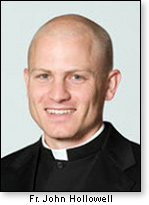
Fr. John Hollowell is not afraid to tell the world that “the Catholic Mass is boring.” And he assures us that this is a good thing. That may sound odd, but he makes a very good point.
What he actually means is that the Mass is not entertaining.
I’ve embedded his homily below, and have summarized it and added my own thoughts.
Fr. Hollowell notes that society places a very high value on entertainment. It’s part of the “all about me” culture. We’re supposed to always be entertained. Purveyors of information have to find an entertaining way to present that information, or it will be ignored. If we aren’t entertained, we are bored, and we’ll just walk away.
Fr. Hollowell also makes the point that most people who leave the Catholic Church do so because of the homilies or the music. If the homilies are bad (read, “not entertaining”), they are not being “fed”, and so they leave. Ditto, when the music is bad (read, “not entertaining”…and usually “not secular enough”). What these folks generally mean is that their emotions are not aroused and they aren’t made to “feel good”.
I think Fr. Hollowell is right. Oftentimes, people are looking for an emotional high at Mass, because they’ve been led to believe that this is what “church” is supposed to be. And if they don’t get the spiritual high, they look elsewhere for their “fix”. And that’s what it is, really. I know; I’ve been there. In the Protestant Pentecostal circles I ran in prior to my conversion to Catholicism, there was a not-so-subtle message that you had to be inspired to raise your hands and wave them in the air, fall down in ecstasy, speak loudly in tongues (or loudly interpret someone else’s “message”), and dance in the aisles, or you were spiritually constipated. A church that didn’t involve such things was deficient, not spirit-filled.
The main point of Fr. Hollowell’s homily is summed up as he quotes a line from the hymn Tantum Ergo:
Praestet fides supplementum Sensuum defectui.
Which is to say, basically: “May our faith supply what our senses fail to grasp.”
As Father points out, we should not even hope to understand what happens at Mass. That God Himself comes down to us at the behest of a priest who stands at the altar in persona Christi, and allows Himself to be physically consumed by us, thereby becoming one with us…well, all of that is just unbelievable. Faith is a major requirement.
And you can’t see that Jesus is truly present in the Eucharist. The host looks the same before and after consecration. Transubstantiation is a mystery that we cannot fathom, even if we have some words to describe it.
The effects of the Mass on our souls are also not always tangible. As Father points out, there may be times when we “feel” something. But feelings are fleeting and unreliable. The important thing is that we know what is happening at Mass; that we ponder the mystery; that we simply receive Our Lord in Holy Communion, knowing that He is present; that we worship God in the liturgy as He has instructed us.
It takes a great amount of faith to be a faithful Catholic.
Funny, one of the favorite songs we sang in my former Pentecostal church was “We walk by faith”. I don’t remember all of the lyrics, but it was a constant theme: we walk by faith and not by sight.
Well, where is that more true than in the Catholic Church?
Our faith is not based on sight! We don’t generally have manifestations of God’s power in the form of angel feathers falling from the ceiling, or people’s dental fillings turning to gold. This, I fear, is a weakness of the Catholic “charismatic” movement; people are turning from faith in the unseen to the seeking of consolations manifested in the physical world.
But we have an even greater miracle at every single (valid) Mass – a miracle that eclipses every other miracle: the bread and wine become the Body and Blood of Our Lord Jesus Christ!
You can’t see it. Catholics walk by faith, not by sight.
Praestet fides supplementum Sensuum defectui. Be sure to check out Fr. Hollowell's blog On This Rock, as well as his second blog, I Have a Say. He is also spearheading the effort to produce a documentary film ("Unnatural Law?") to reveal the truth about homosexuality. He's on Face Book and Twitter, too - see his blog for more info on those . Here's his homily:
A homily
by Fr. Eric M. Andersen, Sacred Heart in Gervais, OR
February
7th, 2013
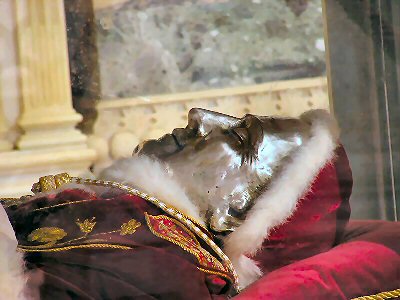
Bl. Pius IX, pope
The Roman Martyrology for the seventh day in the Ides of
February:
At Rome,
blessed Pius IX, pope, who, plainly proclaiming the truth of Christ, near to
whom indeed he cleaved, instituted many episcopal sees, promoted the cultus of
the blessed Virgin Mary and approved the First Vatican Ecumenical Council.
And
elsewhere, many other holy martyrs, confessors, and holy virgins.
Thanks be
to God.
Pope Pius IX was born into a noble family in 1792 and
baptized Giovanni-Maria Mastai-Ferretti. As a child he suffered from epileptic
fits, but they ceased and his health improved as he grew older. His ordination
to the priesthood was even called into question due to his epileptic condition
“but the difficulty was settled by the favor of Pope Pius VII, and it was in
memory of his patron that (he later) took the name of Pius IX when he was
crowned” pope 27 years later in 1846 (The
Popes, ed. Eric John, p. 438).
His predecessor, Pope Gregory XVI had neglected the Papal
States and they had been reduced to a police state near bankruptcy. Pius IX
elevated the way of life for the people of the Papal States and he was very
beloved to the people of Italy. But many assumed that he supported Italian
nationalism (cf. 45). He was caught in an impossible situation when a mob
demanded that he declare war on Austria. While he was the monarch of the Papal
States, he was also the Pope––the spiritual father to the whole world and the
vicar of Jesus Christ. He could not declare war on Catholic Austria. So, he was
labeled an ‘anti-nationalist’ and “Denounced as a traitor to his country” (46).
He had to flee the country in disguise and he took refuge in the Kingdom of
Naples for 17 months.
Meanwhile the
Papal States had been taken over by the mob and declared a democratic republic.
Foreign troops from France, Austria, Naples, and Spain came to the help of the
Pope and restored the Papal States to him in 1850. 1850 was also the year that
the Pope restored the Catholic hierarchy to England and Wales. Shortly after
this, in 1854, he declared the dogma of the Immaculate Conception of the
Blessed Virgin Mary.
Meanwhile, the French Emperor Napoleon III came to favor
a unified Italy and with his support, by 1860, the Italians reduced the Papal
States to include only the city of Rome. The Pope now “saw the Church as a
citadel under siege from all sides” and in response, he released the encyclical
Quanta Cura with the attached “Syllabus of Errors.” Now, he began
organizing and preparing for an Ecumenical Council. In 1870 the Council
convened but was interrupted by the invasion of Rome by Garibaldi and his
troops. King Victor Emmanuel seized Rome as the capital of Italy and Pope Pius
IX became ‘the prisoner of the Vatican’ (47).
Persecution was rampant. Catholics were being persecuted
in Switzerland and France. Three years later in Germany, “the government
claimed full control of the Catholic schools, the education of the clergy and
all clerical appointments” (John, 439). The Pope suffered through these last
eight years of his life as he watched world events with great sorrow. He died
on February 7th, 1878 at the Vatican. He was beatified by Pope John Paul II in
the Great Jubilee Year 2000.
A homily by Fr. Eric M. Andersen, Sacred Heart-St. Louis in Gervais, OR
Feb 3, 2013 Dominica IV Per Annum, Anno C
“If I should have all faith, so that I could remove mountains, and have not charity, I am nothing” (1 Cor. 13:2).
Faith, Hope, and Charity: these three are called the Theological virtues. The greatest of these three is charity. St. Ambrose of Milan comments on today’s gospel and he contrasts charity with envy. He says that the people in the synagogue had no joy in Christ’s charitable works among others. Rather, they were envious of His good works performed for the people of Capernaum. Why would he not perform any good works for them, His own people, in His own country? St. Ambrose writes: “in vain can you expect the aid of Divine mercy, if you grudge to others the fruits of their virtue. The Lord despises the envious, and withdraws the miracles of His power from them that are jealous of His divine blessings in others” (Aquinas. Catena Aurea).
This brings up the question: What exactly do we mean by envy? Is envy the same as jealousy? No, it is not. Envy is different. So, how does envy differ from jealousy? Let’s look at an example: Jealousy means that you want something that someone else has. Your neighbor just bought a new car. You are jealous because you would like a new car. You do not hate your neighbor for getting a new car, but within yourself, you are discontented. You are not satisfied with the things that God has given you. You want what another person has. It is a distraction from growing closer to God. It is a love of worldly things rather than heavenly things.
Envy is similar but different. Envy involves jealousy but envy takes things a big step forward. Here is an example: Your high school classmate is popular, a good athlete, big muscles, lots of money and all the girls swoon over him. If you are jealous of him, you will want what he has. You will not be content with the special gifts that God has given you. Instead you will dwell upon this other person and what he has. But. . . if you are envious of him, you will dwell upon imaginary scenarios in which he breaks his leg and has to sit out of the game for the rest of the season. Then you imagine that his girlfriend breaks up with him and turns all his friends against him. Finally, you take delight in the thought that maybe his father loses his job and then this classmate will be poor, unpopular, and a terrible athlete…just like you.
Envy wants what another person has and wants it to be taken away from that other person. Envy is cruel because it desires that another person should be miserable. It involves revenge. Movies love to portray this: At the high school reunion the ladies stand around taking delight in the fact that the most beautiful and popular girl in high school is now fat, divorced, and on welfare. That is cruel.
That kind of cruel and evil behavior is what we see in today’s gospel: Jesus wants the people to open their hearts and take joy in his good works done for others. He reminds them that prophets have historically given attention to those even outside the chosen people. He recalls the fact that in the time of the great prophets Elijah and Elisha, these prophets performed miracles among the gentiles. Now Jesus is doing the same thing. The people should rejoice, but instead they are envious. They wish to take revenge on Jesus. They drive Him out of the synagogue and up to the crest of the mountain where they intend to kill him. But His hour has not yet come. He passes through their midst.
We must counter envy with charity. Charity is a theological virtue. Charity is also a fruit of the Holy Spirit. It must be practiced. But if a person has practiced envy for some time, then that behavior will become like second nature. It becomes a vice that can destroy that person’s eternal soul. Envy is among the Cardinal or Capital Sins. It is among the worst of sins. We cannot tolerate it in ourselves. We must hate and detest sin. We must do everything in our power to avoid such sin. But our own power is not enough. If you or someone you love struggles with the sin of envy, come to Confession. Confess it! Break it! Do not endanger your salvation by tolerating something so grave.
There is a particular danger in this day and age for Catholics in the United States to be envious of other Christians because other Christians are not facing the same persecution that Catholics are facing. To be Catholic in the United States today means that you will be marginalized. You will have fewer rights than other people simply because of your religion. You might find yourself being jealous of people who are not being targeted and persecuted for their faith. You might even find yourself envious, begrudging others because they seem to have things easy, wishing that they too would be persecuted. But we must be very careful with such thoughts and refrain from speaking them. We must never wish evil or hardship on another person. We must certainly never wish evil on someone who is innocent. And. . . we must never wish evil on someone who has harmed us. Revenge, envy, unforgiveness: these three have no place in a Christian’s life.
But Faith, Hope, and Charity: these three are the theological virtues and the greatest of these is Charity. With the help of the Holy Spirit, let us all cultivate this precious fruit called Charity so that as we restore our souls to a state of sanctifying grave through a good sacramental Confession, we learn to cooperate with the grace of the Holy Spirit to break the vice of envy. Envy sought the life of Jesus Christ. Let us not choose that side of the battle. Let us not battle against God but choose instead to battle against the devil with God on our side!
A homily by Fr. Eric M. Andersen, St. Louis Church in
Gervais, OR
Feb 2, 2013 The
Presentation of the Lord/The Purification of our Lady
AKA. Candlemas
St. Alphonsus de Liguori
reminds us that “Under the Old Law there were two precepts concerning the birth
of firstborn sons. One was that the mother was regarded as unclean and was to
remain in her house for forty days and then purify herself in the Temple. The
other was that the parents of the firstborn son should take him to the Temple
and offer him there to God” (The Glories of Mary. 246).
The offering of a firstborn
son to God was normally done as a sign of redemption. The parents offer the boy
but they exchange the sacrifice of a lamb and a turtledove, or two turtledoves
in his place. Thus they have redeemed their children by means of symbolically
sacrificing this firstborn. With Mary and Joseph this offering of Jesus in the
Temple was different because He would truly be sacrificed as a redemption for
all, but not yet; not now. This offering would consummated and perfected at the
Sacrifice of the Cross, and the Sacrifice of the Altar, but for this day, the
sacrifice was merely being signified by the offering of two turtledoves.
The Word of the Lord had
come to the prophet Malachi in days of old, saying: “Suddenly there will
come to the Temple the Lord whom you seek.” And the Word of the Lord had
come to the prophet Haggai who had spoken: “. . . the Desired of all nations
shall come; and I will fill this House with glory. Great shall be the glory of
this House, more than of the first; and in this place I will give Peace, says
the Lord of hosts.” (2:5,7,8,19). Haggai spoke to the people who had
returned from exile in Babylon. The original Temple of Solomon had been
destroyed. Now, a new Temple had arisen in its place but the people were
disappointed because the Second Temple did not reach the magnificence of King
Solomon’s Temple. But the Lord promised through His prophets that He would fill
this Second Temple with His glory.
At the time when Mary and
Joseph brought the infant Jesus to be Presented, the Ark of the Covenant had
been lost. It was hidden away and never found again. Meanwhile, in the time of
the Maccabees, the Temple had been desecrated by the Greeks and the apostate
Jews who cooperated with them. The Romans had later conquered and placed an
apostate ruler over the Jews.
Now, on this day, forty
days after the birth of the true Bread from Heaven, the Ark of the Covenant is
climbing the steps of the Temple holding in her arms the Glory of the Lord, the
Desired of all nations, who is about to fill the temple with His glory. The
words of the prophet Malachi are fulfilled: “Suddenly there will come to the
Temple the Lord whom you seek.” “The blood of oxen and goats will, for a few
years more, flow on its altar; but the Infant, who holds in His veins the Blood
that is to redeem the world, is at this moment (being held) near that very
altar.” (Gueranger vol 3, pg 467). But today is not the time for a blood sacrifice.
He shed a drop of His blood at His Circumcision on January 1st. That is enough
until His hour shall have come.
Mary and Joseph were in a
procession carrying the light of the world. It was the smallest procession with
the smallest child. So the procession we make today is an expansion on that
first procession. We are the like Mary and Joseph, but also like the Wise
Virgins, carrying in our hands the lamps burning with the flame of charity. The
blessing of candles is one of three major blessings during the year: The
candles, then the ashes, then the palms. Why is it that we associate the candle
with Jesus. We have these candles today. We also have the Easter Candle. What
is the connection?
St. Anselm of Canterbury
considered it this way: We have the wax, the wick and the flame. The wax, which
is the production of the virginal bee, is the Flesh of our Lord. The wick,
which is within, is his Soul; the flame, which burns on the top, is his
Divinity.
It is believed that this
feast is of apostolic origin. It is the final close of the Christmas season,
Feb 2nd. Tonight, after Compline the Marian Antiphon has changed to the Ave
Regina Coelorum which will now be sung through Lent until the Triduum.
_4.jpg/220px-Benedykt_XVI_(2010-10-17)_4.jpg) Pope
Benedict XVI has announced he will resign on February 28. Here is the full text
of Pope's February 11th Declaration to the College of Cardinals:
Pope
Benedict XVI has announced he will resign on February 28. Here is the full text
of Pope's February 11th Declaration to the College of Cardinals: