Friday, March 8, 2013

What Did Vatican II Really Say?


Dr. Peter KwasniewskiThere is an intriguing article at the Corpus Christi Watershed website entitled, “Vatican II and the Reform of the Mass”. The author is Dr. Peter Kwasniewski, who is a Professor at Wyoming Catholic College.

Dr. Kwasniewski notes that

…the Constitution Sacrosanctum Concilium of Vatican II makes nine proposals or mandates concerning the reform of the Mass, no more and no less:

(1) that the rites are to be simplified so that duplications or accretions would taken away;

(2) that the readings from Scripture should be expanded in number and variety;

(3) that the homily be considered an integral part of the liturgy and that it be better prepared;

(4) that the common prayer, or general intercessions, be reintroduced;

(5) that the vernacular be used for the readings and the general intercessions, while the priest’s parts as well as the Ordinary remain in Latin;

(6) that the priest distribute to the people hosts consecrated at that Mass, rather than hosts reserved from another Mass;

(7) that communion under both species be allowed on special, rather rare, occasions;

(8) that the Mass is truly made up of two parts, which we now call the Liturgy of the Word and the Liturgy of the Eucharist, and so the people should be taught to value both parts;

(9) that concelebration be permitted.
 That’s it. The concrete reforms proposed were modest, although that first proposal about “simplification” was rather vague and became the cause of much controversy later on.

Dr. Kwasniewski asks how, given the limited scope of these changes, the current situation of the Church emerged – “where, in the name of reform, adaptation, and inculturation, many of the greatest treasures of our Catholic Tradition were forgotten or suppressed?” Indeed! Rather than answer that question, though, he makes a case for the need to allow post-Vatican II generations to discover the full traditions of the Church. He says:

I was born after the Council had already been closed. In my own life I distinctly remember the excitement, the wonder, of discovering amazing riches in the tradition of the Church, a treasure that had been seemingly deliberately buried and hidden: the noble beauty of plainchant, the dignified and resonant sound of Latin, the shimmering beauty of old vestments, the sprinkling rite (Asperges), even something as simple as the use of incense at the elevation of the consecrated gifts. But it was not only this feast of symbolism and beauty that answered to a burning need for reverence, it was also rediscovering the full social teaching of the Church, her ascetical and mystical theology, her scholastic wisdom, her saints and their stories.

Be sure to read the whole article here.

Thursday, March 7, 2013

The Next Pope and the Traditional Latin Mass: Vortex

This episode from the Vortex is from Monday, March 4. 


You can read the script for the program here.


Sunday, March 3, 2013

Bearing Fruit in the Future: Fr. Andersen


A homily by Fr. Eric M. Andersen, Sacred Heart-St. Louis in Gervais, Oregon

March 3rd, 2013 Dominica III Quadragesimae, Anno C

“Lord, …I shall cultivate the ground around it and fertilize it;
it may bear fruit in the future.”

Just before he was elected Pope Benedict XVI, Joseph Cardinal Ratzinger preached these words:

“How many winds of doctrine we have known in recent decades, how many ideological currents, how many fashions of thinking…The boat of thought of many Christians has often been tossed about by these waves, thrown from one extreme to the other: from Marxism to liberalism, even to libertinism; from collectivism to radical individualism; from atheism to a vague religious mysticism: from agnosticism to syncretism, and so forth. Every day new sects are created, and what Saint Paul says about human trickery comes true, with a cunning that tries to draw people into error (cf. Eph. 4:14).”

The cardinal who became pope continued:

“Having a clear faith, based on the creed of the Church, is often labeled as fundamentalism, whereas relativism, which is letting oneself be tossed and swept along by every wind of teaching, looks like the only attitude acceptable to today’s standards. We are moving toward a dictatorship of relativism that does not recognize anything as certain and that has as its ultimate standard one’s own ego and one’s own desires. However, we have a different standard: the Son of God, true man. He is the measure of true humanism. Being an ‘adult’ means having a faith that does not follow the waves of today’s fashions or the latest novelties. A faith that is deeply rooted in friendship with Christ is adult and mature. It is this friendship that opens us up to all that is good and gives us the knowledge to judge true from false and deceit from truth. We must become mature in this adult faith.”

(Homily at Mass in St. Peter’s Basilica, April 18th, 2005)

This homily of the Cardinal set the tone for his papacy as Benedict XVI. He has been called the “Servant of the Truth.” He has continued to build upon the rock foundation of the Church, cultivating and fertilizing it in hopes that his work will bear fruit. But he knows that he cannot complete the work. He may never see the fruit when it is fully ripe, but he trusts that it will ripen, even after he is gone. In his final Angelus talk, he said “I have felt like St. Peter with the Apostles in the boat on the Sea of Galilee: the Lord has given us many days of sunshine and gentle breeze, days in which the catch has been abundant; [then] there have been times when the seas were rough and the wind against us, as in the whole history of the Church it has ever been - and the Lord seemed to sleep. Nevertheless, I always knew that the Lord is in the barque, that the barque of the Church is not mine, not ours, but His – and He shall not let her sink. It is He who steers her: to be sure, he does so also through men of His choosing, for He desired that it be so.”

Let us give thanks to God for the gift of a pope who would give himself so generously to lead us to truth. The decades since the Second Vatican Council have been difficult ones. Many misconceptions and falsehoods were promoted in the name of the council. Pope Benedict spent himself trying to right those wrongs. He has been very clear in his teaching and writing that the Church must have continuity in doctrine, in liturgy, and in culture. He calls this a “hermeneutic of continuity.” A hermeneutic is a lens, or an interpretation, through which we see something. If we could say that Pope Benedict XVI will be remembered for anything, it would be this concept of restoration or reform in continuity.

What does hermeneutic of continuity mean? It means this: If one of the saints who lived 100 years ago, or 800 years ago, or 1800 years ago were to walk into this church for Sunday Mass, would that saint recognize the Mass we are celebrating? In other words, if St. Therese of Lisieux, or St. Alphonsus de Liguori, or St. Leo the Great, deigned to honor us with their presence here on Sunday, would they know that they were in a Catholic church? We must take care that whatever we do here at Mass, that it is within that hermeneutic of continuity so that a saint from of old would still know that he or she was in a Catholic Church.
 
In contrast we can observe the growing dictatorship of relativism which is becoming the religion of the masses. This religion is dictated by the media which tells people what to think, what to believe, what to feel. We must not ally ourselves with that camp. We must hold firm to the faith and propagate it in our community and in our families. But we must start with ourselves. It all starts with each of us. We must reform our own lives, purify our own souls by living the sacramental life. That will bear fruit for our families, and then for our parish, and then for our country and outward to the whole world. We may never see the fruit fully ripen in our own times, but we must nevertheless cultivate the tree, fertilize it, and pray that it may bear fruit for the glory of God. It is His Church, not ours.

When the throne of Peter is empty, as it is now, we can trust that Jesus is at the helm of the Church. As unsettling as it may be to have the Throne of Peter empty, we are not abandoned. Let us pray for the cardinals as they prepare to enter into conclave. You might want to adopt a cardinal, and pray for him that he will have what it takes to be in concord and unity with the other cardinals and with God in order to resist temptation and do what he is being called to do. In that way, we can participate in this historic event. We have a role to play in the conclave.

Let us thank Pope Benedict XVI for his hard work as the husbandman of the vine which is the Church. Let us heed his words to embrace a mature and adult faith in continuity with those who have come before us. May his work bear abundant fruit even after he is gone. 

Thursday, February 28, 2013

The Collect of the Missal for the Election of a Pope


Yesterday I posted a prayer for the election of a bishop; here is the more appropriate collect of the Missal for the election of a Pope:

Súpplici, Dómine, humilitáte depóscimus :
ut sacrosánctæ Románæ Ecclésiæ
concédat Pontíficem illum tua imménsa pietas;
qui et pio in nos stúdio semper tibi plácitus,
et tuo pópulo pro salúbri regímine sit assídue
ad glóriam tui nóminis reveréndus.
Per Dóminum.

O Lord, with suppliant humility, we entreat Thee,
that in Thy boundless mercy
Thou wouldst grant the most holy Roman Church a pontiff,
who by his zeal for us, may be pleasing to Thee,
and by his good government may ever be honored by Thy people
for the glory of Thy name.
Through Our Lord Jesus Christ.


And if you’re so inclined, you can “Adopt a Cardinal” for whom to pray during the conclave.


Wednesday, February 27, 2013

Prayer for the Election of a Pope


Here is a prayer for the election of a bishop; I have prayed it for the election of a bishop for the Diocese of Baker, the Diocese of El Paso, and the Archdiocese of Portland, but I assume it’s a good one for the universal Church seeking the election of a new Bishop of Rome, as well.

Lord God, you are our eternal shepherd and guide.
In your mercy grant the Church a shepherd who will walk in your ways
and whose watchful care will bring us your blessing.
We ask this through Our Lord…

For those who like to pray in the official language of the Church, here’s the Latin:

Deus, qui pastor aeternus,
gregem tuum assidua custodia gubernas,
eum immensa tua pietate concedas Ecclesiae pastorem,
qui tibi sanctitate placeat,
et vigili nobis sollicitudine prosit. 
Per Dominum...


Here’s a prayer for the Pope. I pray it every day for Pope Benedict XVI, though I guess after February 28, it doesn’t quite “fit” because he will no longer be the Pope. Still, he will remain in my prayers! And surely it doesn’t hurt to pray this prayer for the new Pope, even before we know who he is.

V. Let us pray for N, our Pope.

R. May the Lord preserve him, and give him life, and make him blessed upon the earth, and deliver him not up to the will of his enemies. [Ps 40:3]


O God, Shepherd and Ruler of all Thy faithful people, look mercifully upon Thy servant N, whom Thou hast chosen as shepherd to preside over Thy Church. Grant him, we beseech Thee, that by his word and example, he may edify those over whom he hath charge, so that together with the flock committed to him, may he attain everlasting life. Through Christ our Lord. Amen.

And here it is in Latin:

V. Oremus pro Pontifice nostro N.

R. Dominus conservet eum, et vivificet eum, et beatum faciat eum in terra, et non tradat eum in animam inimicorum eius. [Ps 40:3]

Pater Noster, Ave Maria.

Deus, omnium fidelium pastor et rector, famulum tuum N., quem pastorem Ecclesiae tuae praeesse voluisti, propitius respice: da ei, quaesumus, verbo et exemplo, quibus praeest, proficere: ut ad vitam, una cum grege sibi credito, perveniat sempiternam. Per Christum, Dominum nostrum. Amen.

Sunday, February 24, 2013

Fr. Andersen: Will It Be Sports or God?


A homily by Fr. Eric Andersen, Sacred Heart-St. Louis in Gervais, Oregon
February 24th, 2013
Dominica II Quadragesimae, Anno C

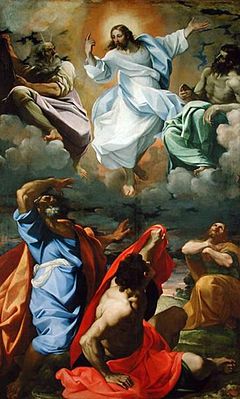
During these forty days of Lent, we accompany Jesus to the Cross. Last week, we heard that Jesus fasted for forty days and forty nights and was hungry. Then the devil tempted Him. Where else do we find this number 40? We find it with Noah, who built an ark which saved him and his family and the animals within while it rained for 40 days and 40 nights. Moses ascended the mountain, Mount Sinai, where he fasted for 40 days and 40 nights in prayer for the sins of his people, and preparing to receive the Law from God. Then there is Elijah who journeyed “through the wilderness. On his way, an angel gave him to eat: and ‘strengthened by that food he went on for forty days and forty nights, when he reached God’s own mountain, Horeb’” (Danielou, The Lord of History, 260-261).

Elijah was then assumed into heaven. He did not die. The scriptures tell us that a chariot of fire came and swept him up into heaven. What about Moses? There is a rabbinic tradition that Moses was also assumed into heaven. The book of Deuteronomy tells us that his body was buried in the valley of the land of Moab but its tomb has not been found (cf. Deut 34:6).  The scriptures also tell us, in the epistle of St. Jude, that Michael the Archangel disputed with the devil over the body of Moses; not over his soul, but over his body. We do not know what the dispute was about.

“The common interpretation is that St. Michael conveyed the body of Moses out of the way, and from the knowledge of the Israelites, lest they should pay to it some idolatrous worship; whereas the devil, for that end, would have it buried, so that the people might know the place and adore it.” (Haydock, p. 1626, fn 9)

We see that temptation fulfilled here with St. Peter wanting to build a shrine, a tabernacle, on that spot for Moses and for Elijah. These two prophets were so highly revered by the Jewish people because they experienced a privileged intimacy with God that others were never given.

The Book of Deuteronomy tells us that “there has not arisen a prophet since in Israel like Moses whom the Lord knew face to face” (Deut 34:10). This is very important because God also told Moses that no man can see the Face of God and live (cf. Exod 33:20). But Moses looked upon the face of God. God spoke to him face to face. And now, Moses and Elijah appear speaking to God face to face, on the Mountain; Our Lord Jesus Christ is transfigured before them and they converse with Him. This scene serves as a fulfillment to a promise from Deuteronomy when Moses told the people: “The Lord your God will raise up for you a prophet like me from among you…him you shall hear” (Deut 18:15). God the Father tells us just that: “This is my beloved Son in whom I am well pleased. Listen to Him!” Let us listen to Him through the teachings of the gospels. But let us not only listen to Him; let us obey Him.
 
Our Lord has commanded that we make holy the Lord’s day. The Lord’s day is Sunday. Every Sunday is the Lord’s day. The whole day Sunday is the Lord’s day. You should not work unless you have to. You should not go shopping on Sunday. You should not participate in school activities or school sports on Sundays. Let me repeat that: You should not participate in school activities or school sports on Sundays – any Sundays – but especially on Palm Sunday. I bring this up because Gervais High School is hosting the Oregon Latino Basketball Tournament which is scheduled to take place on Palm Sunday and on Holy Saturday. This is not appropriate.

The Catholic Daughters were offered an opportunity to do some fundraising at this event, selling hotdogs. In considering the event, I became aware that it falls on a Friday of Lent, continues on Palm Sunday, and finishes on Holy Saturday. Needless to say, Catholics should not attend or support this event. Palm Sunday is not a time for a Basketball Tournament, Latino or otherwise. Holy Saturday is not a time for this type of activity either. Holy Saturday is a day for fasting and not for eating hot dogs. Holy Saturday is a day for praying and preparing for Easter the next day, not for playing basketball in a Youth Jam.  Furthermore, this event is going to be serving meat on the Friday of the event. Remember that the Church asks you to abstain from eating meat on all Fridays through the whole year and that it is a sin to eat meat on Fridays during Lent. If you eat meat on Fridays during Lent, you must go to Confession before receiving Holy Communion again.

Now, if you are engaging in school sports on Sundays you need to make a choice. Will it be sports or God? You have six days to play sports. You have six days to work and make money. God only asks for one day. He not only asks but He has commanded it: Make Holy the Lord’s Day. The principle here is that we do not do anything on Sunday that would accomplish something. We sacrifice getting something done. We sacrifice to God the yield of a day’s labor on Sundays. We sacrifice getting things done. That includes doing homework, or doing anything to earn money. That includes physical labor even if it is a personal project around the house or the yard. Sunday is not a day to tear out a flowerbed in the back yard or to build a new shed.

On the other hand, Sunday is a day to enjoy your family. You can play a game of basketball with your brothers or your uncles, but it should be for fun and not to advance your team’s record. If it is a team that you play for, then you should not play on Sunday because you are accomplishing something, and by doing so you are working. Sunday is a day for rest, for leisure, for family, and most importantly for God. I am asking you to stand up to the schools. They do not dictate how you are live your faith. God dictates that. The schools schedule these events because people go along with them. As Catholics, we need to speak up. Our children will not be involved in such things on Sundays. Our children are not available on Sundays for anything outside of God and the family. If people would stand up to the public schools, things would change. Until very recently, it was unheard of that any school would schedule anything on a Sunday. The same went for Wednesday evenings. Wednesday evenings were reserved for church activities and catechism. Now, the parish is told that the children are not available on Wednesdays because they have sports. We are also told that the children are not available for church on Sundays because they have sports. Beloved in Christ, we have a choice to make. Sunday is the Lord’s Day. It belongs to him. He has a right to command us to cease our work for one day a week.

I realize that some of you are cheering inside because what I say today helps you in your struggles with your children. I received so many thank you’s from parents last night. But I also realize that some of you are shaking your fists at me. I am making life more difficult for you. But I am placing this choice before you because I respect you enough to tell you the truth. I respect you enough to provide you with the information you need to freely make a choice for or against God. And I know that this is a difficult choice placed before some of you. The Latino Basketball Tournament was the springboard for this sermon. But this applies to everyone whether you are Latino or not. I don’t bring this up in order to make your lives more difficult. I bring this up because I love you as your spiritual father in Jesus Christ. I care about your soul. I care so much that I am willing to stand up here and tell you this even when I know that some of you will reject what I have to say. I know that some of you may even go to another parish because the message there is easier.

Well, my dear ones in Christ, the way is narrow that leads to eternal life. There is no such thing as an easy Christian faith. If you want easy, go ahead. You can probably find a priest somewhere who will tell you whatever it is you want to hear. If not, you can make up your own religion and add to the 40,000+ splinters of the Christian faith that are already out there. I may not always tell you what you want to hear, but by now I think you know that I will speak the truth to you because I respect you. The truth will set you free. Jesus Christ is the Truth and He has said that the Truth will set you free. With freedom comes responsibility. We are free when we obey God’s law.

And so I ask you this day to commit to making Sundays a holy day every week. I also want to ask you to boycott the Oregon Latino Basketball Tournament because the organizers have scheduled this event during the most holy time of the year for Catholics. Please do not participate in this event. I say this with love as your spiritual father because you are so precious to God and His commandments are the way to eternal life. Which way will you choose? Will it be sports or God? 

Saturday, February 23, 2013

Statement on Liturgical Workshop in Bend, OR

The Board of the Society of St. Gregory the Great is disappointed to note the following in the “Parish News” section of the Diocesan Chronicle:

Catholic Composer, author, and workshop presenter David Haas will present an evening concert at 7:30 p.m. Friday, March 8 and liturgy workshop Saturday, March 9 from 8:30-2:30 at St. Francis Church in Bend [Oregon]. A few of Haas’ well known songs are “You Are Mine,” “Blest Are They,” and “We Will Rise Again.”

Although it is certainly legitimate for the faithful to invite a composer/performer such as David Haas to present a concert if they so desire, there are other problems to be addressed with the entire scenario.

First, there are Church regulations about concerts in churches. Although the Society does not agree that music composed by David Haas qualifies as sacred polyphony, it is obviously condoned by our local church leadership, and is used at Mass. However, we do hope that the performers will not be situated in the sanctuary, because such a location is prohibited by the Church documents. In addition, a “suggested donation” is mentioned for those wishing to attend the concert; we hope that this is indeed only a suggestion and not a requirement, as an admission fee to a concert in a church is expressly forbidden by the documents. It is also unfortunate that this concert apparently necessitates the cancellation of the Stations of the Cross – a situations which bring to light the problematic fact that this parish is sponsoring a concert during Lent.

More problematic is the “liturgical workshop” that that is scheduled. We wonder what qualifies the composer of “pop” worship music to conduct such a workshop. It does not appear that he truly understands what the Church asks of us with regard to liturgical music and worship, since his music consists primarily of what one would consider “hymns”, or perhaps more correctly “songs”.  We note that the “new translation” implemented in Advent of 2011 brought us a new edition of the Roman Missal which includes more music than any other previous edition, and the form of this music is not hymns, but Gregorian chant antiphons and psalmody.

With the introduction of the new translation, the intent of the bishops was clearly to induce the priests and the faithful to “sing the Mass”, rather than to “sing AT Mass”, and they did not have “hymns” in mind. Prior to the implementation of the new translation, the USCCB’s website promotion of the changes stated (emphases added):

[The Church] has been blessed with this opportunity to deepen its understandingof the Sacred Liturgy, and to appreciate its meaning and importance in our lives… [T]he parish community should be catechized to receive the new translation.  Musicians and parishioners alike should soon be learning the various new and revised musical settings of the Order of Mass.

During the calendar year 2011, the Society of St. Gregory the Great attempted to bring the idea of “singing the Mass” to our parishes by offering a liturgical workshop based on Mystical Body, Mystical Voice presentation developed by Fr. Douglas Martis and Mr. Christopher Carstens of The Liturgical Institute in Chicago. The workshop was conducted in two locations in our diocese, but went no further, for reasons which will not be addressed here.

It is the Society’s mission to promote divine worship in accordance with the Supreme Magisterium of the Church. We believe that this is also the intent of the USCCB in the development and attempted implementation of the new translation of the Roman Missal. However, without the leadership and direction of the local bishop, it is unlikely that there would be uniform changes to the liturgical music used in any diocese. Across the US, there have been some bishops who have taken action toward catechizing the faithful about the music: Bishop Thomas Olmsted in the Diocese of Phoenix; Bishop Joseph B. McFadden of the Diocese of Harrisburg; and Bishop Alexander Sample of the Diocese of Marquette (and, please God, he may bring new life to liturgical reform in the Archdiocese of Portland when he takes on his new assignment!).  None of these bishops offered a workshop by David Haas, as far as we are aware! Instead, they used more authoritative resources and more liturgically appropriate programs.

The Society of St. Gregory the Great remains steadfast in its commitment to the promotion of reverence and beauty in the Mass. We sincerely hope that the faithful of our diocese will soon experience liturgical catechesis that is more likely to foster knowledge and love of our Catholic tradition and identity. We stand ready to help in any effort to implement more liturgically correct music in the Mass.