Sunday, April 7, 2013

Divine Mercy Sunday: Fr. Andersen

A homily by Fr. Eric M. Andersen,  Sacred Heart-St. Louis in Gervais, OR

April 7th, 2013

Divine Mercy Sunday

In the nineteen-twenties, a young religious sister in Poland began receiving visions of our Lord who spoke to her heart about His divine mercy. This young sister, St. Faustina Kowalska, was commanded by her superiors to write a diary about these locutions. Jesus commanded her to tell the world that the second Sunday of Easter – which is today – be celebrated as a feast to the Divine Mercy. He told her: “In the Old Covenant I sent prophets wielding thunderbolts to My people. Today I am sending you with My mercy to the people of the whole world. I do not want to punish aching mankind but I desire to heal it, pressing it to My Merciful Heart. I use punishment when they themselves force me to do so; My hand is reluctant to take hold of the sword of justice. Before the Day of Justice I am sending the Day of Mercy” (Diary 1588).

He showed her an image of Himself in which rays poured forth from His heart, a red ray for His precious blood, and a white ray for the cleansing waters of Baptism. He taught her this prayer based upon the image: “O Blood and water, which gushed forth from the heart of Jesus as a fount of mercy for us, I trust in Thee” (187). He instructed her that when anyone said this prayer “with a contrite heart and with faith on behalf of some sinner, (He would give that sinner) the grace of conversion” (cf. 186). This is the way that each of the faithful exercises his duty of the common priesthood. Each of the baptized is called upon to intercede for others, to do penance for the sake of the world, in reparation for sins and for the conversion of sinners. This is one aspect of divine Mercy. Jesus said to St. Faustina: “When a soul approaches Me with trust, I fill it with such an abundance of graces that it cannot contain them within itself, but radiates them to other souls” (cf. Diary. 1074-76).

In the Gospel, Jesus breathes on His chosen apostles and gives them the power to forgive sins - or to withhold forgiveness for the sake of a soul’s conversion. These chosen men are to mediate His mercy and justice. This is another aspect of the Divine Mercy. Jesus said: “Tell my priests that hardened sinners will repent on hearing my words when they speak about My unfathomable mercy, about the compassion I have for them in My Heart. To priests who proclaim and extol my mercy, I will give wondrous power; I will anoint their words and touch the hearts of those to whom they will speak.” I trust, as a priest, that when I speak these words from the Diary of St. Faustina, that these words are truly anointed. I trust that because these words are truly anointed, that hardened souls will be converted, even if these hardened souls are not actually here physically among us. I trust that you the faithful, who hear these anointed words, will take heed and pray the Divine Mercy for the conversion of those whose hearts are hardened and whose souls are in danger of being eternally lost. Each of you can make a difference by your prayers.

To the faithful who avail themselves of this message, Jesus said: “When you approach the confessional, know this, that I Myself am waiting there for you. I am only hidden by the priest, but I Myself act in your soul. Here the misery of the soul meets the God of mercy. The torrents of grace inundate humble souls. The proud remain always in poverty and misery, because My grace turns away from them to humble souls. . . . If their trust is great, there is no limit to My generosity” (1602). “Let the weak, sinful soul have no fear to approach Me, for even if it had more sins than there are grains of sand in the world, all would be drowned in the unmeasurable depths of My mercy” (1059). “I will grant a complete pardon to the souls that will go to Confession and receive Holy Communion on the Feast of My mercy” (1109).

Most beautifully of all, Jesus confirms that the person of the priest is only a screen. He tells us: “Never analyze what sort of a priest it is that I am making use of; open your soul in confession as you would to Me, and I will fill it with My light” (1725).

Today is a feast to proclaim that mercy, that forgiveness of sins for all sinners. Jesus said, “I desire that the Feast of Mercy be a refuge and shelter for all souls, and especially for poor sinners. On that day the very depths of My tender mercy are open. I pour out a whole ocean of graces upon those souls who approach the Fount of My Mercy. The soul that will go to Confession and receive Holy Communion shall obtain complete forgiveness of sins and punishment. On that day all the divine floodgates through which graces flow are opened. Let no soul fear to draw near to Me, even though its sins be as scarlet. My mercy is so great that no mind, be it of man or of angel, will be able to fathom it throughout all eternity. . . . Mankind will not have peace until it turns to the Fount of My Mercy” (Diary 699).

Jesus warned St. Faustina to write this: “Souls perish in spite of My bitter Passion. I am giving them the last hope of salvation; that is, the Feast of My Mercy. If they will not adore My Mercy, they will perish for all eternity” (965). …“before I come as a just Judge, I first open wide the door of My mercy. He who refuses to pass through the door of My mercy must pass through the door of My justice…” (1146)… tell souls about this great mercy of Mine, because the awful day, the day of My justice, is near” (965).

Let us remember that God’s justice is tempered by His mercy. God wishes to pour out His abundant mercy upon us. But we have to desire that mercy. We must ask God from the depths of our hearts to pour out His mercy on us. We have to acknowledge that we are in need of His mercy. We have to acknowledge that we are all sinners in His sight. Then, He will pour out His abundant ocean of mercy upon us. Jesus tells us to go to sacramental Confession to receive this ocean of grace and mercy. And He asks us to pray the Divine Mercy chaplet in order to obtain mercy for others. He asks us to pray for poor sinners so that their hearts might be converted and that they might repent and come back to God and to the Church; so that they would be set free from slavery to sin and the darkness and misery that accompany it.

3 pm is the hour of mercy. It is the hour that Jesus died on the Cross out of love for us. Today and every day at 3 pm, we are invited to pray the Divine Mercy Chaplet. Catholic Radio KBVM 88.3 FM broadcasts the Divine Mercy every day at 3. Please listen and pray along.

Here at Sacred Heart in Gervais, we will pray the Divine Mercy at 3 pm during our monthly parish Holy Hour. I will also be hearing Confessions from 1:45 until 2:45. I ask that if you go regularly to the Sacrament of Confession, please leave this time open so that those who have been away from the sacrament for a time can avail themselves of the ocean of mercy poured out on this special feast day. 

Thursday, April 4, 2013

Installation Homily of Archbishop Sample


INSTALLATION HOMILY
Reverend Alexander K. Sample
Archbishop of Portland in Oregon
April 2, 2013
Photo taken by Marc Salvatore;
it also appears on Archbishop Sample's Face Book page.


Praised be Jesus Christ, risen from the dead, who lives and reigns forever. Amen!

It is in the true spirit of Easter joy that I greet all of you here as the newly installed shepherd of God’s flock in western Oregon.

I wish to express my gratitude to His Eminence, Cardinal Levada, a former Archbishop of Portland and Prefect Emeritus of the Congregation for the Doctrine of the Faith, for gracing us with his presence today.

I am most appreciative for the presence of His Excellency, Archbishop ViganĂ², Apostolic Nuncio to the United States, who has presented the papal bull appointing me Archbishop of this local Church and who has formally installed me as its chief shepherd. Your Excellency, your presence with us today brings a special closeness of our Holy Father, Pope Francis, and reminds us all that we are part of the universal Church of Jesus Christ.

I want to thank and acknowledge a very special person to all of us, Archbishop Vlazny. I want to thank you, Your Excellency, for the very kind and gracious welcome you extended to me to this Archdiocese from the moment of our first telephone conversation after my appointment here. But most of all, on behalf of the entire Church of the Archdiocese, I want to thank you for your faithful and beautiful ministry as its shepherd for all of these past 15 years.

My brother bishops, priests and deacons, dear consecrated religious, my dear brothers and sisters in Christ, and all people of good will, to you I repeat the words of the psalm: “This is the day that the Lord has made, let us rejoice and be glad in it!”

I say this not because of the installation of a new Archbishop, but because Jesus Christ has risen from the dead. He is alive, he loves us, he calls us to faithful discipleship, and he asks us to be witnesses of his resurrection before the world.

You see, there is the danger on such an occasion to think that this is somehow all about your new Archbishop or this local Church. We must always keep our eyes fixed on Jesus. It is not about me. It is always about him, and we must never lose sight of that.
In these readings from the Acts of the Apostles which the Church gives us during these first days of the Easter octave we have St. Peter, in the power of the Holy Spirit on the day of Pentecost, standing before the people and proclaiming Jesus Christ, as risen from the dead.

His is truly a bold and fearless proclamation of the Good News meant for all those whom God calls. He is fulfilling the mission that Jesus Christ entrusted to him and the other Apostles.

This is what is needed in the Church today. We need a new Pentecost, a new outpouring of the Holy Spirit to set our hearts on fire for proclaiming Jesus Christ. With hearts filled with joy, love and mercy, we must proclaim the Good News.

I come to you as your new Archbishop to announce afresh to you, the disciples of Jesus Christ, that he is alive! This is good news, not just for the disciples of 2000 years ago, but for us today. It is good news for all people. Jesus is alive and has become for us the source of eternal life. By his death he has destroyed death, freed us from the corruption of sin and opened up for us the way to the Kingdom of Heaven. This is the basic message of salvation and we must never cease to believe it and proclaim it.

I would like to draw your attention to my episcopal motto: Vultum Christi contemplari, “to contemplate the face of Christ.” You must know that, for me, this is more than just a nice phrase. It speaks clearly and directly of my vision for our work together here in western Oregon.

The inspiration for this motto is taken from the writings of Blessed John Paul II, specifically from his apostolic letter at the beginning of the new millennium, Novo Millennio Ineunte and his last encyclical, Ecclesia de Eucharistia.

In Novo Millennio Ineunte, he writes: "’We wish to see Jesus’" (quoting the Gospel of St. John). This request, addressed to the Apostle Philip by some Greeks who had made a pilgrimage to Jerusalem for the Passover, echoes spiritually in our ears too during this Jubilee Year. Like those pilgrims of two thousand years ago, the men and women of our own day — often perhaps unconsciously — ask believers not only to ‘speak’ of Christ, but in a certain sense to ‘show’ him to them. And is it not the Church's task to reflect the light of Christ in every historical period, to make his face shine also before the generations of the new millennium? Our witness, however, would be hopelessly inadequate if we ourselves had not first contemplated his face.”

Nemo dat quod non habet! No one can give what one does not have! We cannot give Jesus Christ to others until we have first come to know him intimately and profoundly.

In the Gospel today we see Mary Magdalene as the first one to announce the risen Lord. Jesus tells her to go and tell the other disciples this good news, that he is alive. And so she does.

But notice that she did not recognize him at first, and that it is only after she has gazed at him, recognized him, that she is able to proclaim him to the others as risen from the dead. He called her name and she responded.

But why did she not recognize him at first. This is a question long pondered by scripture scholars and those who have reflected on the Gospel. Perhaps she was distracted by her own grief and worry. Maybe she was anxious and pre-occupied.

In any case she failed to gaze at him, to really look at him. Is this the case for us today? Are we so distracted, anxious, fearful and pre-occupied with the business of daily living that we too have failed to look intently at Jesus, to recognize him, to contemplate his face?

Before we can proclaim him to others, we too must first recognize him. We must really see him. We must contemplate his risen face before we can announce him to others.

We must hear the Lord Jesus call our name, as he called Mary, and as she recognized him, so must we. But then we must proclaim him!

This Year of Faith, in which this installation of your new Archbishop takes place, is meant to help us do just that. This year is meant to strengthen our faith by contemplating Christ’s face and the mystery of our faith in order to prepare us for the supremely important work of the New Evangelization, the great mission that is before us. To really set about the work of the New Evangelization in earnest, however, our faith must first be strengthened.

In his letter to the Church proclaiming this Year of Faith, Pope Benedict XVI quoted some powerful words of the great St. Augustine: “Believers strengthen themselves by believing.” This is a time for strengthening our own faith, so that we can better witness to the love, the mercy and the truth found in the Lord Jesus Christ. But we strengthen that faith by believing more firmly and devoutly that which has been revealed to us by Almighty God in the Sacred Scriptures and in the living Tradition of the Church.

This will require holiness. We need saints for our own day to be the salt of the earth, the light of the world, and a leaven in society. We are above all called to holiness, and our times demand that we answer that call with renewed zeal and vigor.

There are many challenges facing us in these times. We are witnessing an almost unprecedented and increasing radical secularism that seeks to push God out of the picture, and not just to the margins of society, but even right off the page of human experience in society today.  

We are also facing what Pope Benedict XVI, and now Pope Francis, have called a dictatorship or tyranny of relativism. There is no longer in our society a recognition that there are some eternal and unchangeable truths, especially about the very nature and dignity of the human person. This is a serious challenge when we can no longer dialogue with our contemporaries from a common understanding of the innate and essential nature of the human person.

And then there are the challenges of our own making. We cannot hide from the fact that the scandals that have plagued the Church in recent years have seriously damaged our standing and credibility in the wider society in which we seek to proclaim the Gospel of Life. This great Archdiocese has certainly not been spared this tragedy.

When I refer to these "challenges of our own making," I mean that some of your leaders, your pastors, your shepherds have seriously let you down and done grave harm to individuals. We can never express too much sorrow and regret for the harm that has been done and we must never relax our efforts and our pledge to help heal victim survivors of sexual abuse and to protect children and young people.

So it is with humility but with a firm purpose that we go about our renewed efforts to proclaim the Good News. But we must be strong in our own faith, convinced of the light and truth of the Gospel of Jesus Christ.

As those called to be witnesses to Jesus Christ in the world, we must move beyond the days of doubting and questioning our Catholic Faith, wringing our hands in the face of so many difficulties and challenges. In the face of so many challenges today, how will we ever convince the world of Jesus Christ if we ourselves are not convinced?

We must witness and speak of our faith before others with confidence and clarity and with the greatest charity. But speak of Jesus Christ and our faith, we must. And we must not forget that which will our greatest witness to Jesus Christ, and that is the love, the mercy and the compassion that we show toward those who suffer; the poor, the marginalized, the abandoned, the lonely and forgotten. The modern day “widows and orphans” that Sacred Scripture admonishes us to care for. How beautifully our new Holy Father, Pope Francis, is showing us the way by example.

In the midst of our challenges we must continue to bear witness to the dignity of human life and every human person from the womb until natural death, the dignity of marriage and the good of children, a special love for the poor and marginalized, and religious liberty.

I am so very happy that so many of our ecumenical and interreligious brothers and sisters have joined us today in this celebration. I will truly value and respect our friendships and relationships and will work hand in hand with our brothers and sisters in promoting the true common good and the dignity of every human person.

And so, my dear brothers and sisters, it is time, in the words of Blessed John Paul II to “duc in altum” – to put out into the deep sea of history and to let down the nets for a catch, leading others to the love of God in Jesus Christ.

Duc in altum! (Put out into the deep!) These words ring out for us today, and they invite us to remember the past with gratitude, to live the present with enthusiasm and to look forward to the future with confidence: ‘Jesus Christ is the same yesterday and today and forever’”.
Duc in altum! – no matter how difficult or even hopeless the challenges may seem, Jesus Christ has risen from the dead. He is alive and is with us and will make it happen. What he needs is our faith and trust. We repeat the words that Jesus taught to St. Faustina: Jesus, I trust in you!

Now we turn towards the Holy Eucharist, the source and summit of the Christian life. We must not merely celebrate so wonderful a mystery. We must be transformed by and imitate the mystery we celebrate. We must lay down our lives for God and in service to others, in imitation of Jesus who came not to be served but to serve and to give his life as a ransom for the many.

This is my Body, which is given up for you. This is my Blood which is poured out for you. As he has done for us, so we must do for one another. Such a heroic virtue and self-giving is what is needed in our times.

I have been deeply inspired by the holiness, the zeal and missionary fervor of the first bishop of my former diocese, Venerable Frederic Baraga, whose own heroic virtue has been recognized for the whole universal Church by Pope Benedict XVI. He came to the upper Great Lakes region as a missionary and a stranger from another land. I feel a strong bond with him as I come to you also as a stranger from another place. I ask his prayers for me as I take up my new pastoral responsibility among you. They say, “Home is where the heart is.” I know my home will be here, because you will have my heart.

Blessed John Paul wrote in Ecclesia de Eucharistia: “To contemplate the face of Christ, and to contemplate it with Mary, is the ‘programme’ which I have set before the Church at the dawn of the third millennium, summoning her to put out into the deep on the sea of history with the enthusiasm of the new evangelization.”

It is to my Mother and your Mother, Mary Immaculate, the patroness of this great Archdiocese that I entrust my ministry as your shepherd. May she form in me the likeness of her Son, Jesus, who is the Good Shepherd.

God bless you, and please pray for me! 

Monday, March 25, 2013

Prayers for the Virtue of Humility

Prayer of St. Ephrem the Syrian

O Lord and Master of my life, take from me the spirit of sloth, despondency, lust of power, and idle talk.
But grant rather the spirit of chastity,
humility, patience, and love to thy servant.

Yea, O Lord and King, grant me to see my own transgressions, and not to judge my brother,
for blessed art Thou unto the ages of ages. Amen


Litany of Humility

O Jesus meek and humble of heart, Hear me.
From the desire of being esteemed,
 deliver me, Jesus.
From the desire of being loved,
deliver me, Jesus.
From the desire of being extolled…
From the desire of being honored…
From the desire of being praised...
From the desire of being preferred to others…
From the desire of being consulted…
From the desire of being approved…
From the fear of being humiliated…
From the fear of being despised…
From the fear of suffering rebukes…
From the fear of being calumniated…
From the fear of being forgotten…
From the fear of being ridiculed…
From the fear of being wronged…
From the fear of being suspected…

That others may be loved more than I,
Jesus grant me the grace to desire it.
That others may be esteemed more than I,
Jesus grant me the grace to desire it.
That in the opinion of the world,
others may increase, 
and I may decrease…
That others may be chosen and I set aside…
That others may be praised and I unnoticed…
That others may be preferred to me

 in everything…
That others may become holier than I,
provided that I become as holy as I should…
Amen.


Little Girl Gets some Help From Divine Providence
Abandonment Prayer

I adore you, God the Father, who created me;
I adore you, God the Son, who redeemed me;
I adore you, O Holy Spirit, 
            who have so often sanctified me,
            and are still sanctifying me.
I consecrate to you my whole day 
            for the pure love of you,
            and for your greater glory.
I do not know what is to happen to me today,
            whether troublesome things 
            or pleasant ones,
            or whether I shall be happy or sad,
            in consolation or in grief.
It will all be as you please.
I abandon myself to your providence,
            and I submit to all your wishes.

Sunday, March 24, 2013

Palm Sunday Homily: Fr. Andersen


A homily by Fr. Eric Andersen, Sacred Heart-St. Louis in Gervais, Oregon

March 22nd, 2013 Dominica in Palmis de Passione Domini

On the feast of the Epiphany, we commemorated the three Gentile kings who came to pay homage to the Infant who was King of the Jews. Today, the same King of the Jews is acknowledged by the Jews themselves. The Gospels tell us that in the end times, the Jews will acknowledge Christ as the Messiah. Today’s first Gospel, read before the blessing of palms, is a prefigurement of the end times, when the Jews hail Him as Messiah King just before He finishes His earthly mission. They do this holding palm branches. In the Old Testament, on the feast of Tabernacles, God commanded that His people take branches of palm trees, and boughs of thick trees, and willows, along with ripe fruit, and rejoice. Holding palm branches in a procession is a sign of joy, so when the children of the Hebrews come out waving palm branches, it is a sign of joy. And there is a strange sense of joy on Palm Sunday. It is joy mixed with sorrow. We begin hailing the King of the Jews and we end by shouting out, “Crucify Him! Crucify Him who called Himself the King of the Jews.”

Let’s return to this joy for a moment. We have been focusing on self-denial, repentance, sin, and God’s mercy through these forty days. In the Easter Season, we will recall to mind the gift of Baptism that gives new life through water and the Holy Spirit. Water is life-giving and we see that outside. Spring is in bloom. Nature is coming to life and as the flowers begin to bloom, the sun and the rain refresh them and nourish them with new life after a long winter. This Sunday has been historically called by the name of Pascha Floridum which means “Easter in bud,” about to burst forth in flower. The state of Florida got its name from Spanish explorers who discovered it on Palm Sunday in the year 1513, the day of Pascha Floridum, and named it Florida in honor of this great feast of Our Lord.  

Our souls are like those flowers which have waited out the long winter of salvation history. Our souls are like gardens filled with buds about to burst forth. The Father has determined the times and seasons and brought us to this springtime of great promise. Jesus is like the sun which lights our way and warms us. The Holy Spirit is like the rain which refreshes us and gives us life. So if today is Easter in bud, about to burst forth in bloom, then we need to take special care of these gardens which are our souls. We need to take special care that the buds do not wither before they have a chance to bloom. 

Saturday, March 23, 2013

Saturday of Passion Week: The Collect


In general, I find all of the (extraordinary form) collects for the days of Passiontide edifying and inspirational. I particularly like the collect for Saturday of Passion Week:

Orémus
Proficiat, quaesumus Domine,
plebs tibi dicata piae devotionis affectu:
ut sacris actionibus erudita,
quanto majestati tuae fit gratior,
tanto donis potioribus augeatur.

Let us pray
We beseech thee, O Lord,
may the people who are dedicated to Thee
advance in piety and devotion:
and instructed by these sacred rites,
may they abound in ever greater gifts,
as they become more pleasing
in the sight of Thy Majesty.


Friday, March 22, 2013

Fr. Rodriguez: The Devastated Vineyard


This is a great homily from Fr. Michael Rodriguez for Passion Sunday. It’s long – almost 40 minutes – but important. I’ve summarized it below, but I know I haven’t done it justice. You’ll be greatly rewarded if you find time to listen to it in its entirety!


Fr. Rodriguez opens his homily by reading from the visions of Venerable Anne Catherine Emmerich and her description of the sufferings Jesus will have to endure. There are four great sufferings Our Lord has to endure:

·          His own torture and death on the Cross
·         The sufferings of His Blessed Mother
·         The future sufferings of His Mystical Body, the Church
·         His own sufferings in the Blessed Sacrament

Our Lord’s awareness of these future sufferings made His experience all the more painful and sorrowful. Fr. Rodriguez draws particular attention to the description of the abuses Our Lord has to endure in the Blessed Sacrament – the offenses and outrages committed against Him there.

Here’s a sample – I’m not sure if Fr. Rodriguez actually read this section, but it at least gives the flavor of the vision (I found it here):

…Angels came and showed Him, in a series of visions, all the sufferings that He was to endure in order to expiate sin; how great was the beauty of man, the image of God, before the fall, and how that beauty was changed and obliterated when sin entered the world...

The soul of Jesus beheld all the future sufferings of His Apostles, disciples, and friends; after which He saw the primitive Church, numbering but few souls in her fold at first, and then in proportion as her numbers increased, disturbed by heresies and schisms breaking out among her children, who repeated the sin of Adam by pride and disobedience. He saw the tepidity, malice, and corruption of an infinite number of Christians, the lies and deceptions of proud teachers, all the sacrileges of wicked priests, the fatal consequences of each sin, and the abomination of desolation in the kingdom of God, in the sanctuary of those ungrateful human beings whom He was about to redeem with His blood at the cost of unspeakable sufferings. The scandals of all ages, down to the present day and even to the end of the world — every species of error, deception, mad fanaticism, obstinacy, and malice — were displayed before His eyes...

Fr. Rodiguez devotes the second part of his homily to three topics: 1) obedience, love, and prayer for our new Holy Father; 2) the grave crisis in the Church today; and 3) the importance of each of us making reparation for sins.


On the first point, Fr. Rodriguez notes that all Catholics are required to pledge obedience to our new Pope, to try to grow in love for him, and to pray and sacrifice for him. Why? Because of our love for Our Lord Jesus Christ; the Pope is the Vicar of Christ, and so we have a unique love, obedience, and devotion to him.

However, this obedience and love takes place in a context: we are required to obey God’s Commandments and the Traditions of the Church. As the Vicar of Christ, the Pope also stands for these things – he is not separate from them.

The second point in Father’s sermon is the fact that the main issue in the Church today is the grave crisis in which we find ourselves. While we should certainly have joy in the election of a new Holy Father, we must not lose sight of the fact that there is a crisis. The vineyard of the Lord is devastated: there is a loss of faith, of a sense of  the supernatural. The new Pope is being called to correct the crisis.

Cardinals, bishops, and others are offering many commentaries on the new Pope, but, says Fr. Rodriguez, “not too many are weeping over the wounds of Holy Mother Church and everything she is suffering.” We need to pray for the Pope because he has his work cut out for him. “In practically every parish in the world, the Catholic faith has been lost and lessened.”

The evidence of the devastation is the fact that Church dogma and doctrine are not being taught any longer. Fr. Rodriguez offers a list of the truths that seem to have gone missing:

·         Extra ecclesiam nulla salus – outside the Church there is no salvation
·         Christ must reign in both private and public life
·         The authority of the Pope, not “collegiality”, is a supreme authority
·         The sanctity of marriage
·         The sanctity of life (sinfulness of abortion and artificial contraception)
·         Belief in the Real Presence of Jesus in the Eucharist

What sense is there in talking about the election of the new Pope if we don’t acknowledge the reality of the crisis, and recommit ourselves to fight for our Catholic identity and the truths taught by the Church? According to news reports, says Fr. Rodriguez, the vast majority of cardinals seem to use as their priority for selecting a pope, the likelihood that he would deal with the reform of a corrupt Roman Curia – all the while expressing the notion that more collegiality is needed.

Fr. Rodriguez contends that there is corruption in the Roman Curia because of the loss of faith. Why point solely to the Roman Curia? he asks. Shouldn’t these cardinals be thinking about their own diocesan curia back home? The same devastation of faith that seems to be taking hold of the Roman Curia exists in every diocese in the world.

Cardinals, suggests Fr. Rodriguez, should make every effort to bring about reform and restoration of the faith in their own backyard. They should make sure their priests are preaching the truths of the faith. It is hypocritical to talk about corruption in the Roman Curia without also talking about the corruption in dioceses everywhere.


Fr. Rodriguez uses this loose analogy: the foundation of the Church is Peter – the rock. A false foundation has been laid in the post-conciliar period; it’s supposed to be “new” and “better”, but this new foundation is cracked and falling down. The Church doesn’t need collegiality, he concludes. The Church needs “greater love, fidelity, respect, honor, and prayer for the Vicar of Christ. The Church needs a rock-solid papacy.”

Our Lord Jesus Christ gave the keys to the Kingdom to Peter and his successors; he didn’t make 12 sets and give one set to each of the Apostles; he didn’t break up the one key and divide it amongst them. When it comes to dogma, “collegiality” is only one small part; the greater part is the papacy.

In all the hoopla about the election of the new pope – which is a good thing – we must not lose sight of the devastation in the vineyard. And that brings us to the third point: reparation. 

Fr. Rodriguez returned to the point that we must look to ourselves and not just point fingers at the Roman Curia. Bishops and priests must pay attention to and make reparation for abuses going on in their own dioceses and parishes. And the laity too must make reparation.

The two areas where the abuses are most rampant and dangerous are in the Holy Sacrifice of the Mass and in the attitude toward the Eucharist. Fr. Rodriguez reminds us of the beginning of his homily, where he read from the vision of Venerable Sister Anne Catherine Emmerich, in which she describes the horrible abuses of the Sacrament that Jesus Christ must suffer. He exhorts us to make reparation for the abuses that occur in the liturgy and against the Blessed Sacrament by being more reverent in our own actions. He suggests that we offer our Holy Communion for all those who are receiving unworthily, and for other sacrileges that are being committed against the Eucharist.

We should also pray for the restoration of the Traditional Latin Mass, Father reminds us.
Fr. Rodriguez mentions the sermon in which Pope Francis said he was dreaming of a Church that is poor, and that is for the poor. While acknowledging that that is an admirable thought and sentiment, Fr. Rodriguez notes that he himself would dream of and long for a Church that seeks the Glory of God above all things, and the salvation of poor souls; and insofar as poverty is a powerful means to achieve that, so be it.

And in the TLM, Fr. Rodriguez maintains, that is what the Church is doing: give glory to God and saving souls. Those are the goals of the Traditional Mass. The Novus Ordo, on the other hand, he says, “was not fabricated with those goals in mind. The motivation was active participation of the faithful, and an effort not to offend non-Catholics.” With these motivations, we cannot expect the Novus Ordo to achieve what the TLM can achieve, even when the NO is said with reverence and devotion.

Wednesday, March 20, 2013

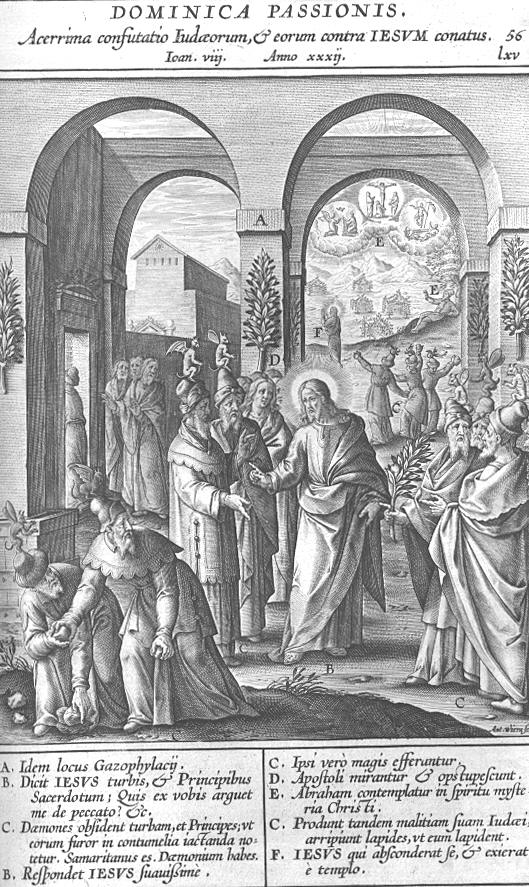
Passion Sunday and the Pope


A homily from Mass in the Extraordinary Form for Passion Sunday:

The scene from today’s Gospel passage takes place in Jerusalem, in the Temple precincts.

Jesus is approaching the end of his three-year ministry, and the dark clouds of persecution have appeared in the sky: His enemies have already tried to kill him at least once.


He and His disciples have departed Jerusalem for Galilee, because things were getting a little too hostile. 
When the feast of Tabernacles approached, Jesus’ disbelieving cousins – James, Joseph, Simon, and Judas – encourage Him to return to Judea (where Jerusalem is located), “so that your disciples may see the works you are doing”, as they put it. “No one works in secret if he wants to be known publicly. If you do these things, manifest yourself to the world.”
Eventually He does go up to Jerusalem, secretly, arriving halfway through the week-long feast. He heads directly for the Temple, and there begins to teach. And immediately His teaching causes consternation: his hearers “were amazed and said, ‘How does he know scripture without having studied?’” So He didn’t graduate from a recognized yeshiva, a seminary! Horrors!
Then Jesus confronts His critics directly on their accusation that He couldn’t be from God because He “broke the Sabbath”: He had healed the paralytic at Jerusalem’s Pool of Bethesda . . . on the Sabbath!

Jesus said to the Jews: “Why are you trying to kill me?” [i.e., capital punishment by stoning]  The crowd answered, “You are possessed! [i.e., insane] Who is trying to kill you?” Jesus answered and said to them, “I performed one work and all of you are amazed because of it. 

“Moses gave you circumcision...and you circumcise a man on the Sabbath. If a man can receive circumcision on a Sabbath so that the law of Moses may not be broken, are you angry with me because I made a whole person well on a Sabbath? Stop judging by appearances, but judge justly.”

The problem with the Scribes and the Pharisees – the legal and religious leaders of the Jews – was that they didn’t have a “pigeonhole” in which to fit this upstart from Galilee. He wasn’t of the priestly tribe, he wasn’t known to be a student of any of the recognized rabbinical schools, and yet here He was – in the TEMPLE!!! – presuming to teach the people. Just who did He think He was?!?

No doubt they had heard the tales of his teaching and miracles in Galilee – including the claims that He had cured lepers, expelled demons, gave sight to a man who had blind from his birth, and even raised the dead (!) – and were both skeptical and jealous of His increasing popularity with the people, who regarded Him as a prophet. In the process, they had closed the ears of their hearts to the voice of God, to what the Holy Spirit was doing in their midst.

Jesus said to the Jews: “Whoever belongs to God hears the words of God; for this reason you do not listen, because you do not belong to God.”

And so they realized that He was becoming a threat to the status quo: to their own stature among the people. They had to find some plausible way of accusing Him of sin, of publicly discrediting Him...and, if necessary, of getting rid of Him once and for all.

“Teacher, this woman was caught in the very act of committing adultery. Now in the law, Moses commanded us to stone such women. So what do you say?”

This phenomenon is not something that happened just two thousand years ago. It is not something that happened solely to Our Lord. It has continued to happen over and over again.

Did not Our Lord warn The Twelve at the Last Supper:

John 15:18.   “If the world hates you, realize that it hated me first. If you belonged to the world, the world would love its own; but because you do not belong to the world, and I have chosen you out of the world, the world hates you. Remember the word I spoke to you, ‘No slave is greater than his master.’ If they persecuted me, they will also persecute you.”

While it is not difficult to apply these words to ourselves as the victims of persecution, it is perhaps more challenging to consider whether or not we ourselves have taken on the role of the persecutors. Jesus’ enemies repeatedly tried to pigeonhole Him, and when they couldn’t find a convenient category to which to consign Him and thus to dismiss Him, they sought to discredit him...and eventually killed Him.

Are there people whose words and actions defy our own preconceived “pigeonholes”? What is our reaction or response to someone who thinks, speaks, and acts outside our own frame of reference? Are we attentive to the possibility that the Holy Spirit might be challenging us – as It challenged the Scribes and Pharisees – to consider anew that the all-knowing, all-powerful, all-merciful, all-just God of the universe is not bound by the fallible constructions of limited, human thought?

This past week the cardinal electors chose His Eminence, Jorge Mario Cardinal Bergoglio, Archbishop of Buenos Aires, as the 266th Successor to the Prince of the Apostles, Bishop of Rome, Supreme Pontiff of the Universal Church, and Vicar of Christ. Within seconds of the announcement from the balcony of the loggia of St Peter’s Basilica, the five thousand accredited journalists gathered in Rome began sending their stories to their respective news outlets across the globe.


The initial reaction was surprise – the first Jesuit, the first non-curial cardinal, the first from the Americas, etc., etc. The most common adjective used to describe the pontiff-elect was “humility”.

And within hours critics on both sides of the political spectrum began digging for “dirt”: that he was anti-gay marriage, anti-abortion, anti-contraception, anti-divorce; that as Jesuit provincial he was complicit in the kidnapping and torture of two of his priests, that he failed to fix the “dilapidated state of his clergy”; that he was lukewarm to implement Pope Benedict XVI’s 2007 Apostolic Letter, Summorum Pontificum that lifted the restrictions on the offering of Mass in the older form, etc.

Ever since the white smoke was first seen rising from the chimney on the roof of the Sistine Chapel and the announcement “Habemus Papam” was made, I have been asked repeatedly, from multiple sources both inside and outside the Diocese, some variation of the same question: “Will Pope Francis suppress the Latin Mass?” And to all, I give the same answer: “I don’t know.”

The only information I have is what I read on the Internet, which I’ve learned long ago to take with a very large grain of salt. What I’ve seen is replete with speculation, innuendo, prognostications, and rumors . . . but very short on facts. In sum, I find insufficient data to make any reasonable assessment or prediction in this regard.

Nevertheless, our obligation as Catholic Faithful is first and foremost to be ever more open to the working of the Holy Spirit, conforming our minds and our hearts to Our Lord.

“Whoever belongs to God hears the words of God; for this reason you do not listen, because you do not belong to God.

Do we “belong to God”? Do we hear the words of God speaking to our hearts at every moment? Or have we – like the Scribes and Pharisees of Jesus’ day – already decided in our hearts what God is permitted to say and not say, what His servants are permitted to do and not do?

Of course, God is never ‘yes’ one moment, and ‘no’ the next, as St. Paul tells us. Not even a pope can teach something that contradicts Sacred Scripture and Sacred Tradition. But in the ordering of the life of believers there have always been, from time to time, some aspects of ecclesiastical governance that have been necessarily refined or corrected in order that the purity of the Gospel may shine more brightly in a world that sits in darkness, in the shadow of death.

Every vocation – every authentic calling from God – has its own charism. Every newlywed husband and wife, for example, soon realizes that, although the charism of “husband-ness” and “wife-ness” is conferred in the administration of the sacrament, it takes time and effort for the humanness of the individual to conform itself to the grace of the vocation.

So also is it with the vocation to the Petrine ministry, to the papacy. Cardinal Bergoglio will need the space of time to conform himself to the grace of his new vocation as the Successor to St. Peter, as the Vicar of Christ. Give him that space, give him the support of your prayers and sacrifices. Be not quick to judge him for not conforming to preconceptions of what he ought to do or not do. Rather, show yourselves as “belonging to God”, eager to hear the words of God.