Thursday, July 25, 2013

Interview with Cardinal Burke: ZENIT

ZENIT has an exclusive interview with Cardinal Raymond Leo Burke today. The interview was conducted “on the sidelines of Sacra Liturgia 2013, a major international conference on the liturgy held in Rome at the end of June”. Cardinal Burke has some interesting things to say – be sure to read the entire interview!

Here are some excerpts (my emphases):

ZENIT: Some argue the liturgy is mostly about aesthetics, and not as important as, say, good works done in faith. What is your view of this argument that one often hears?

Cardinal Burke: It’s a Communist misconception. First of all, the liturgy is about Christ. It’s Christ alive in his Church, the glorious Christ coming into our midst and acting on our behalf through sacramental signs to give us the gift of eternal life to save us. It is the source of any truly charitable works we do, any good works we do. So the person whose heart is filled with charity wants to do good works will, like Mother Teresa, give his first intention to the worship of God so that when he goes to offer charity to a poor person or someone in need, it would be at the level of God Himself, and not some human level.

ZENIT: Some also say that to be concerned with liturgical law is being unduly legalistic, that it’s a stifling of the spirit. How should one respond to that? Why should we be concerned about liturgical law?
Cardinal Burke: Liturgical law disciplines us so that we have the freedom to worship God, otherwise we’re captured – we’re the victims or slaves either of our own individual ideas, relative ideas of this or that, or of the community or whatever else. But the liturgical law safeguards the objectivity of sacred worship and opens up that space within us, that freedom to offer worship to God as He desires, so we can be sure we’re not worshipping ourselves or, at the same time, as Aquinas says, some kind of falsification of divine worship.

ZENIT: It offers a kind of template?

Cardinal Burke: Exactly, it’s what discipline does in every aspect of our lives. Unless we’re disciplined, then we’re not free.
ZENIT: … What basis of liturgical formation do we need in our parishes, dioceses and particularly in our seminaries?

Cardinal Burke: The first important lesson that has to be taught is that the sacred liturgy is an expression of God’s right to receive from us the worship that is due to Him, and that flows from who we are. We are God’s creatures and so divine worship, in a very particular way, expresses at the same time the infinite majesty of God and also our dignity as the only earthly creature that can offer him worship, in other words that we can lift up our hearts and minds to him in praise and worship. So that would be the first lesson. Then to study carefully how the liturgical rites have developed down the centuries and not to see the history of the Church as somehow a corruption of those liturgical rites. In the true sense, the Church over time has come to an ever deeper understanding of the sacred liturgy and has expressed that in several ways, whether it be through sacred vestments, sacred vessels, through sacred architecture – even the care for sacred linens which are used in the Holy Mass. All of these are expressions of the liturgical reality and so those things have to be carefully studied, and of course then to study the relationship of liturgy with the other aspects of our lives.


Read the rest here.

Monday, July 15, 2013

Fr. Andersen: The Holy Choir of Virtues

A homily by Fr. Eric M. Andersen, Our Lady of Peace Retreat, Summer Catechetical Institute

July 14th, 2013

Dominica XV Per Annum, Anno C.

Second Reading: (Col. 1:15-20) Christ Jesus is the image of the invisible God,the firstborn of all creation.For in him were created all things in heaven and on earth,the visible and the invisible,whether thrones or dominions or principalities or powers;all things were created through him and for him.He is before all things,and in him all things hold together.He is the head of the body, the church.He is the beginning, the firstborn from the dead,that in all things he himself might be preeminent.For in him all the fullness was pleased to dwell,and through him to reconcile all things for him,making peace by the blood of his crossthrough him, whether those on earth or those in heaven.
This week, I will be talking about human anthropology, from the theological perspective: virtues, vices, the appetites, the passions, and the will. Today’s second reading (Col. 1:15-20) prepares us for this anthropological study. We start with Christ. St. Paul explains to us that Jesus Christ is the image of the invisible God. We start there. God is invisible, or in other words, He is pure spirit. But God is not limited to remaining invisible. He just does not depend upon matter in order to exist. He is pure spirit, and therefore, He is invisible. But according to His divine and perfect will, He became incarnate, taking on human flesh. It was not God the Father who became incarnate, but God the Son. This brings us back to Colossians: The Son is the image of the invisible God. God is pure spirit, and therefore invisible, but the Son has taken on material existence, and therefore He is visible.

We could say that the first man, Adam, was also the image of the invisible God. Moses teaches us that Adam was made in the image and likeness of God. But Adam was made. Jesus was begotten not made. Jesus is the only begotten of the Father:

“ …in Him were created all things in heaven and on earth, the visible and the invisible.” So Adam and all things visible on earth were created in Jesus Christ. But St. Paul tells us that heaven was also created and that all things invisible were created in Jesus Christ: thrones, dominions, principalities, powers. Elsewhere, St. Paul writes of the angels called the virtues. The scriptures also tell us about angels, archangels, cherubim, and seraphim. These names identify the nine choirs of angels which we encounter regularly in the prayers of the Holy Mass.
 
What can we learn about anthropology by studying these nine choirs of angels? Let’s look briefly at these nine choirs and how they are hierarchically ordered. St. Thomas Aquinas, keeping with Dionysius the Areopagite, “divides the angels into three hierarchies each of which contains three orders. Their proximity to the Supreme Being serves as the basis of this division. In the first hierarchy he places the Seraphim, Cherubim, and Thrones; in the second, the Dominations, Virtues, and Powers; in the third, the Principalities, Archangels, and Angels” (Pope, Hugh. "Angels." The Catholic Encyclopedia. Vol. 1. New York: Robert Appleton Company, 1907. 14 Jul. 2013 http://www.newadvent.org/cathen/01476d.htm>.)

Venerable Prosper Gueranger writes this about the nine choirs of angels:

“It is from the lowest of the nine choirs, the nearest to ourselves, that the Guardian Angels are for the most part selected. God reserves to the Seraphim, Cherubim, and Thrones the honour of following His Own immediate court. The Dominations, from the steps of His throne, preside over the government of the universe; the Virtues watch over the course of nature's laws, the preservation of species, and the movements of the heavens; the Powers hold the spirits of wickedness in subjection. The human race in its entirety, as also its great social bodies, the nations and the churches, are confided to the Principalities; while the Archangels, who preside over smaller communities, seem also to have the office of transmitting to the Angels the commands of God, together with the love and light which come down even to us from the first and highest hierarchy. O the depths of the wisdom of God! Thus, then, the admirable distribution of offices among the choirs of heavenly spirits terminates in the function committed to the lowest rank, the guardianship of man, for whom the universe subsists” (The Liturgical Year. Vol. XIV, Feast of the Guardian Angels).

We see in this hierarchy of the angels a mirror of the hierarchy of visible things. Man is the highest of the visible beings, because among visible beings, he is closest to God. But among the invisible creation, the Guardian Angels are the lowest because they are the closest to man.

All of these beings, visible and invisible, were created in Christ. He holds all things together in Him. He is the head of the body, the Church. So the holy angels share communion with mankind as members of the Mystical Body of Christ in the Church. Just as we pray to the saints for their intercession, let us remember to pray to the holy angels for their intercession.  We are here to speak this week of human virtues. But we can see here that the Virtues, among the holy angels, can be of great help to us.

For instance, the Holy Choir of Virtues watch over the course of nature's laws, the preservation of species, and the movements of the heavens (the weather). Let’s put these angels to work in these three areas! God has created the natural law. Let us first pray to the Holy Virtues that the Natural Law may be respected and guarded especially in the preservation of marriage between one man and one woman. Let us pray secondly for the preservation of species, especially of the human race. In the face of rapidly declining birth rates around the world, forced sterilizations, the use of abortifacient birth control and abortion, let us pray to the Virtues for increased birth rates, a culture of life, and the preservation of the human race. Thirdly, let us pray to the holy Virtues for their intercession in the movement of the heavens––for good weather. May they intercede for farmers and all who depend of the weather for crops, especially during this summer season. Let us pray also for protection against natural disasters caused by weather and for safe travel for all who travel in the air, on the seas, through mountain passes, and all who are in danger due to inclement weather.


Let us entrust these all these intentions to the Holy Choir of Virtues through Christ our Lord. “For in him all the fullness was pleased to dwell, and through him to reconcile all things for him, making peace by the blood of his cross through him, whether those on earth or those in heaven”. 

Thursday, July 11, 2013

Diocese of Baker Chant Workshop

click for more information on Gregorian Chant Conference

The Diocese of Baker is holding a Gregorian chant workshop! This is certainly welcome news!

Here are the details from the Diocese of Baker website; I’ve lifted everything from the flyer, which you can find here.

Date: August 15 - 17, 2013

Registration information:

Patti Rausch Diocese of Baker Chancery Office
prausch@dioceseofbaker.org 541-388-4004

General information:

Judy Newport
mothermarysdhtrs@aol.com 541-923-6946

You’ll notice, of course, that the conference coincides with the Feast of the Assumption of the Blessed Virgin Mary. Mass for that feast will be celebrated by Bishop Liam Cary at 7pm at St. Mary’s Chapel at the Powell Butte Retreat Center.

According to the brochure, the Gregorian Chant conference will provide a unique and much needed focus on how to understand Gregorian chant and its place in the Sung Roman Liturgy. The four lectures cover the topics:

What is Gregorian Chant;

The origins and history of Gregorian chant;

How Gregorian Chant fulfills the criteria for Traditional Art and Sacred Music;  

Differentiation of Gregorian chant according to form and function within the liturgy;

The sung liturgy and the music designated for priest, deacon, lector, schola, and congregation;

Church documents on Gregorian Chant.

St. Mary's Chapel
The conference will also provide workshops for those who want to learn to sing the Order of Mass and the Ordinary of Mass. This will include introduction to solfage and the reading square note notation.

The conference will be conducted in the context of prayer and spiritual renewal with the sacrament of reconciliation, daily Mass, and the liturgy of the hours.

The conference will end with the Vigil Mass Saturday at 7:00 pm for the 20th Sunday in Ordinary Time celebrated by Fr. Daniel Maxwell. For those who are staying overnight, it will end with sung Compline.

The speakers and celebrants for the event are as follows:

Dr. Lynne Bissonnette-Pitre
Featured Lecturer and Workshop Leader: 

Lynne Bissonnette-Pitre, MD, PhD  

Lynne is a physician specialized in psychiatry, practicing in Portland, Oregon. She earned a bachelor’s degree from Cornell University; a doctorate at John Hopkins University; and a medical degree at University of California, Irvine. She did her internship and residency in psychiatry, as well as two years fellowship in child psychiatry, at the University of Oregon.

Lynne’s background in music includes proficiency in the musical instruments: piano, viola, alto saxophone, and mandolin. She played in orchestra, marching band, and jazz band, and sang in choir and a women’s ensemble while in school. Lynne sang in the Portland Cathedral choir for 12 years, and has served for 7 years as director and cantor for the Gregorian Chant Schola Cantus Angelorum. She has also sung in Gregorian Scholas in Corning, New York; Atlanta, Georgia; and Bavaria, Germany.

Workshop LeaderYumiko Rinta

Yumiko has studied piano for 17 years, is proficient in voice and flute and, has played in ensembles and sung in the choir in Tokyo, Japan. She studied harpsichord in Portland, Oregon, under Nancy Metzger, who now resides in Sacramento, California. Nancy Metzger is a renowned harpsichordist/organist, author, and professor of music. In the US, Yumiko has sung with the Saint Paul Cathedral Choir and the St. Mary’s Cathedral choir in Portland, Oregon. She has been cantor and co-director of Schola Cantus Angelorum for 7 years.

Workshop Leader: Reverend Daniel Maxwell

As a convert from the Anglican tradition, Fr. Maxwell has a deep love of the sacred liturgy and of sacred music. He served as organist and cantor for several parishes for nearly twenty years before his ordination in 2009 as a priest of the Diocese of Baker.

Liturgy Celebrants:
Bishop Cary
Most Reverend Liam Cary,
Bishop of Baker, Oregon

Baker Diocese to ordain first priest in three years
Reverend Daniel Maxwell,
Pastor of Our Lady of Angels,
Hermiston, OR
Father Greiner
Reverend Robert Greiner,
Pastor of St. Joseph,
Prineville, OR

Wednesday, July 10, 2013

What Vatican II Didn't Say: The Vortex

Do you really know what Vatican II said about the Mass, or are you the victim of some misrepresentations about the changes that occurred? Michael Voris gives you a quick run down on what Vatican II did NOT say - but which many people think it did - in this Vortex.

Read the document in question yourself: Sacrosanctum Concilium.

Saturday, July 6, 2013

Sacred Music Colloquium Report

This is a report from the President of the Society of St. Gregory the Great, Stephanie Swee, on her attendance at the Sacred Music Colloquium, which took place in Salt Lake City, Utah, June 17-23.
For the second year in a row, I was privileged to attend the Sacred Music Colloquium of the Church Music Association of America (henceforth referred to as CMAA). For the second year in a row, it was held in the beautiful Cathedral of the Madeleine in Salt Lake City.

It felt very much like coming home, not only because of the venue, but because there were some familiar faces among the more than 200 who gathered: some of the staff of CMAA whom I had gotten to know previously, some clergy, such as Father Johannes of the Gray Franciscans, and Father Pasley, the chaplain of CMAA, who is pastor of the only diocesan parish in the country dedicated to the extraordinary form of the liturgy.

In addition, there were five other Oregon residents there, besides the two of us who came from Central Oregon. Father Eric Andersen, until recently pastor at Sacred Heart in Gervais and his choir director Jeannine; Father Luan Tran, pastor of St. Birgitta’s parish in Portland and his choir director, a young man whose name I never ascertained; and a gentleman from Otter Rock on the coast, whom I met once at the opening dinner and never saw the rest of the week.

Initially, SLC was characteristically hot. After enduring a Mass the first night in the choir school chapel (no air conditioning) with outside temps of 109 degrees, we were grateful for highs in the mid-80s the rest of the week, and most classrooms and the cathedral were mercifully cooled.  Once I was in the cathedral itself, however, everything seemed very familiar and comfortable. The structure, with its incredible frescos, stained glass, and massive organ is perhaps as close as one gets in the U.S. to the great cathedrals of Europe.  
The choir stalls provided a lot of seating for some of the schola groups, and the choir loft and screened area behind the altar accommodated other singers. The acoustics are very good in most areas and that made singing more satisfying than it is in more dampened new churches, where carpet and ceiling tiles often absorb much of the sound.

As last year, there were six liturgies planned: two EF and four OF Masses. Most of the priests – more than a dozen of them attending – concelebrated the OF Masses, and the choir school chapel was available for those needing to say private Masses. I suspect most did that in the early morning, so as to avoid being cooked and/or dehydrated.

The Masses were structured for the weekdays so as to begin with English OF Masses, first with the New English Propers – amazingly simple in the context – and then with Latin propers, more complex but very do-able by any choir willing to put in the time. Despite the fact that I looked forward to the two Solemn High EF Masses on Thursday and Friday, I found the two preceding Novus Ordo Masses very edifying. They were a great improvement over how most such Masses are celebrated in my local diocese. The music, of course, was key, as chant in both languages and sacred polyphony accompanied the action of the liturgy.

After a late start due to a failed alarm the first morning, I decided to rejoin my previous schola director, Jeffrey Morse, currently choirmaster at St. Stephen’s Church, a Fraternity of St. Peter parish in Sacramento , CA. Even though the level of chant preparation was down from the advanced schola, we had five or six men who were very good cantors and who did all the intoning and psalm verses. In addition, since we had less ambitious participants content to rehearse, Jeffery was able to give us instruction in semiology, the applying of ancient text and markings to interpreting the chants. Although we stayed with the general reforms of Solesmes for the chant, some nuances were added here and there based on more recent scholarship.

Wednesday was a day for one of the highlights of the week. Archbishop Alexander Sample, newly installed as archbishop of the Portland archdiocese and metropolitan for the states of Oregon, Idaho, and Montana, visited for the day and gave a talk that brought tears to the eyes of many  colloquium participants. He thanked the CMAA for continuing to carry the torch for good sacred music and pledged to do all in his power to further those efforts. One of the priests there said to me afterwards that he had never expected in his lifetime to hear a member of the hierarchy say those things. The gratification and gratitude on the part of every participant was immense.

That evening Archbishop Sample celebrated an OF Mass ad orientem and with some Latin chants. It occurred to me – and others, as it turned out – that he is cut from the same cloth as was the Venerable Fulton Sheen. Both have charismatic qualities and both are dignified in their bearing and courageous in their attitude toward the faith. In Archbishop Sample’s case, this includes especially the restoration of the sacred in liturgy and music, which has lain in ruins for so long. It was a note of hope and optimism sorely needed in the Church.

Thursday brought the first EF Mass, the traditional Solemn Requiem for deceased members of CMAA. Monsignor Richard Schuler is always remembered by name, for his incredible contribution to the cause of sacred music. For nearly four decades he conducted Masses by Mozart, Haydn and other composers and used Gregorian chant at many Masses at the Church of St. Agnes in St. Paul, Minnesota. His legacy lives on in the Twin Cities Catholic Chorale and CMAA will have a special workshop there in October.

On Friday, we celebrated the feast of the young Jesuit, Aloysius Gonzaga, with another solemn high Mass, led by Father Pasley as celebrant. On Saturday, the 2 p.m. Mass was an OF Mass in Latin in honor of Our Lady. The group I was singing with did the beautiful Salve Sancta Parens Introit.

The colloquium wound up Sunday morning celebrating the regular 11 a.m. parish Mass at the cathedral with the pastor, Mgsr. Mayo, as celebrant. After Mass the entire group sang a new composition, Laudate Dominum, selected from several pieces of sacred music submitted for judging.

At the closing brunch, Jeffrey Tucker, editor of CMAA’s publication Sacred Music, made a few remarks. A man not known for his brevity, Tucker said that words had failed him in describing the experience of the colloquium. He opined that the bonding felt among participants would continue throughout the year and that the staff was happy to be in touch with any and all.

Father Pasley, though, said something that struck a particular chord with me. He thanked all the participants for their rendering of the sacred music and its contribution to the liturgies that week. He told us that our efforts had made the clergy better priests and that at times, he felt chills on hearing the beautiful sounds that befit  the Sacrifice of the Mass done properly.

Next year the colloquium will be held in Indianapolis, Indiana, much farther east. I hope to be there, but it is a long way out to plan. What I did get from some of the staff is that they are considering Portland as a venue in the next few years. Between the friendship of Archbishop Sample and the more temperate climate, that would be very happy event.   Meanwhile, there are signs of progress in Oregon and perhaps some of the wonderful liturgy that happened in Salt Lake City this summer will be echoed around our state over the next months of 2013. 

If anyone wants more information about CMAA or its activities, including the last colloquium, please e-mail me at: swee0574@gmail.com

Tuesday, July 2, 2013

Awe And Reverence in the Mass: Compare and Contrast

Rorate Caeli recently posted an exclusive article by Fr. Richard G. Cipolla recently: “The Devirilization of the Liturgy in the Novus Ordo Mass”. Fr. Z commented on this article, nicknaming it “The Wussification of the Mass”. I plan to write a post highlighting some of the points made there, but I encourage you to read the entire article.

That said, I turn my focus to that article in conjunction with two videos that have been making the rounds lately. This is a “compare and contrast” exercise that brings out a point made in Fr. Cipolla’s article; he says that his essay was inspired by the comment made by Cardinal Heenan of Westminster to the Synod of Bishops in Rome after the experimental Mass was presented for the first time in 1967 to a group of bishops. Here’s Cardinal Heenan’s comment:

“At home, it is not only women and children but also fathers of families and young men who come regularly to Mass. If we were to offer them the kind of ceremony we saw yesterday we would soon be left with a congregation of women and children.”

 Now with only that quote in mind, watch these two video. The first is rather short; the second is longer, but worth every minute. For this initial comparison, though, you might just watch a bit after the 2 minute mark, and maybe skip forward to the various parts of the Mass depicted.


Fr. Cipolla gives a brief explanation of his term “devirilization”, explaining that “feminization” and “effeminization” are terms that come to mind, but which are inadequate and misleading to some extent. He summarizes (my emphases):

This is the term, devirilization, that I want to use to describe what Cardinal Heenan saw that day in 1967… In its Novus Ordo form… the Liturgy has been devirilized. One must recall the meaning of the word, vir, in Latin. Both vir and homo mean “man”, but it is vir alone that has the connotation of the man-hero and is the word that is often used for “husband”. The Aeneid begins with the famous words: arma virumque cano. (“ I sing of arms and the man-hero.”) What Cardinal Heenan presciently and correctly saw in 1967 was the virtual elimination of the virile nature of the Liturgy, the replacement of masculine objectivity, necessary for the public worship of the Church, with softness, sentimentality and personalization centered on the motherly person of the priest.

Now, for a third example, play back the “video” in your mind of the typical Mass at your parish, especially if you belong to a Novus Ordo parish where there are no huge, glaring liturgical abuses (like a Halloween Mass or a Balloon Mass), but where the music excludes Gregorian chant and sacred polyphony, and the priest celebrates Mass facing the people. 
How does the typical, run-of-the-mill parish Mass compare to the reverence and dignity seen in the second video above? 

I think Fr. Cipolla is onto something here.

Sunday, June 23, 2013

Fr. Andersen Homily: True Beauty Wounds Us

A homily by Fr. Eric M. Andersen, 
Sacred Heart-St. Louis in Gervais, Oregon

June 23rd, 2013

Dominica XII Per Annum, Anno C.


“If anyone wishes to come after me, 
he must deny himself
and take up his cross daily and follow me.”

Friday was the feast day of St. Aloysius Gonzaga. This young saint died at the age of 23. His confessor, St. Robert Bellarmine, testified that young Aloysius had never mortally offended God. At lunchtime on Friday, I was eating lunch with another priest and two young men who are discerning their possible vocations to the priesthood. We got in a conversation about St. Aloysius. The mere mention of this young saint’s name called to mind the beauty of his pure soul. St. Aloysius is the patron saint of youth, which applies to teenagers and also to young adults who are single. He is especially appointed to these because of his purity.

Can you imagine what it would be like to glimpse the soul of a saint? What would his soul look like? I would dare to say that if God allowed us to see the beauty of St. Aloysius’ pure soul, we would weep.
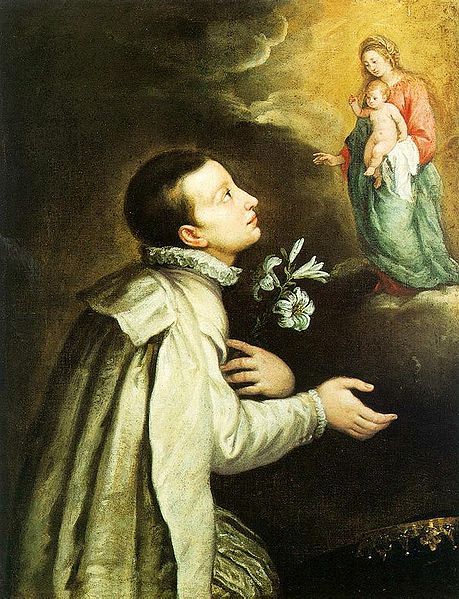
Why do I say that? Because true beauty wounds us. The beauty of which I speak is what we call the transcendental beauty of God. In other words, the beauty of God transcends all earthly beauty. Beauty is one of the transcendental qualities of God. For instance, we say that God is the fullness of Truth, Goodness, and Beauty. These are called the transcendental qualities of God because they transcend earthly truth, earthly goodness, and earthly beauty. All created things that are beautiful pale in comparison with the fullness of beauty which we find in God. We call these created things beautiful by analogy only. Nothing can be truly beautiful that is not God Himself. But we see glimpses of God’s beauty in created reality…and the nearer things are to God, the more beautiful they are. So when we consider the beauty of a pure soul; the soul of a saint like that of St. Aloysius sanctified in heaven; of course his soul would pale in comparison with the beauty of God, but it would still be so beautiful by analogy that we would weep at the mere sight of it.

Perhaps that is one aspect of the Cross about which our Blessed Lord speaks in the Gospel. He says “If anyone wishes to come after me, he must deny himself and take up his cross daily and follow me.” Can we say then that beauty is a cross, or even a burden? I propose that we can. To discover beauty brings with it an obligation to guard and protect that beauty because it is precious. Truth, goodness, and beauty all necessitate that we guard and protect them because they are precious. This is a cross.

It is a cross because once one discovers truth, then one feels the burden of spreading that truth. But it is not a burden to speak truth and defend it. It is an absolute joy to know truth, to speak truth, and to defend truth. The burden, or cross, of Truth is the grief that one experiences when others reject Truth. One grieves for the souls of those who reject truth. Those souls will never know true joy because they are deprived of that which causes true joy. That which causes true joy is Truth Himself, who is God. Jesus Christ declares this. He says “I AM the Truth.” To embrace the absolute Truth incarnate, Jesus Christ, is a cross. But it is a necessary cross that we must pick up daily and carry.

Goodness too is a cross for the same reason. There will be those who reject goodness. And there are those who reject beauty. And so beauty too is a burden, a cross. Beauty is a cross in a different way. Let me clarify that when I refer to beauty, I am not referring to that which is pretty or attractive. Beauty is much greater than that because it is a reflection of God.  
When one experiences true beauty, then that person’s life changes. That person must carry the cross of grief knowing that others chase after created things which are not beautiful…nor true…nor good.

And yet the Truth, Goodness, and Beauty of God would surely change the lives of all men if only they could come to discover these and embrace them. St. Peter was given the truth of who Jesus is: the Christ, the Son of God. Flesh and blood did not reveal this to him, but our Heavenly Father revealed it by means of the Holy Spirit of Truth. It brought St. Peter great joy throughout his life when hearts were converted to Jesus Christ, who IS Truth incarnate. But it surely brought him great sorrow when people he spoke to, preached to, and cared about rejected Jesus Christ and the Gospel.

In our day and age, there is a rejection of truth, goodness and beauty. People are willing and even wanting to settle for less. It is as though they are repelled by beauty and therefore by goodness and truth.

Beauty is looked upon with distrust and even disdain by many in the artistic community, as though “beauty is a bad thing” (Wolfe). In a (lecture given at the CL School of Community in Portland a few years ago), (Professor) Gregory Wolfe asked: “What is the impetus for the in-your-face ugliness of modern art?” He answered this rhetorical question by citing Plato’s Republic. According to Plato, poets were dangerous because they employed beauty in order to seduce. Wolfe continued: “Pleasure scares us because it is powerful.” Puritans and Marxists judged beauty to be dangerous to justice and truth in the order of society. The result of this attitude has been the separation of beauty from art. Art has become subjective, while beauty has been tamed “by making it pretty” (Wolfe). (Andersen. Hymnody in the Roman Breviary. p. 44).

Can we see the same thing happening with marriage? Ever since society accepted the separation of procreation from marriage, the institution of marriage has become subjective. But marriage is not subjective. It has nothing to do with whether one thinks one is married. It is an objective, binding, and legal fact. One is either married–objectively and legally–or not.
 
Marriage is a reflection of the love of God. St. Paul calls the love of Christ for His Church a spousal love which is reflected in the love of a man for a woman in marriage. He calls marriage a great sacrament that applies to Christ and His Church. Marriage therefore participates in the True, Good and Beautiful because it is a reflection of God. Marriage transcends the earthly relationship because it participates in a heavenly reality. When one fully realizes the Truth, Goodness, and Beauty of marriage, then one is obliged to defend and guard it. Therein lies the Cross, especially today when marriage is under attack. We hear again the words of the Lord: “If anyone wishes to come after me, he must deny himself and take up his cross daily and follow me.”

We as Catholics are in a position to defend many things which are true, good, and beautiful. Marriage seems to be at the forefront today. The current political situation calls for the Church to stand up and vigorously defend marriage. Not only must we defend marriage, but we must defend our freedom to defend marriage. This Fortnight for Freedom which the Church has proclaimed in our great country, seeks to make you the Catholic faithful aware that our religious freedom is threatened. Truth is being obscured. Goodness is being mocked. Beauty is being degraded.

We are made for beauty, for goodness, and for truth. We are made in the image and likeness of God, and since God is the fullness of Truth, Goodness, and Beauty, we participate in these qualities and are to imitate Him and reflect Him in these qualities. In this is the cross of Christ that we are to carry. We have been given so much. We cannot keep it to ourselves. We must guard and protect all that is truly good, truly beautiful. We must guard and protect the institution of marriage. That will be our cross. It is a joyful Cross, a light burden, a sweet yoke.


Like the pure soul of a saint like St. Aloysius, if we were to see the beauty of holy matrimony as God sees it, it would make us weep. It would wound us in such a holy way that our lives would be changed. We would take up that cross and proclaim it to the world. We must live, however, by faith and not by sight. Perhaps we have not been given the gift to see that transcendent beauty. But many of us have wept at the sight of something holy and beautiful. That is a gift from God and a cross that we must embrace. We are given this beautiful cross to carry: to guard and defend the truth, goodness, and beauty of holy matrimony between one man and one woman, as a lifelong union for the procreation and raising of children and the good of the spouses. What a beautiful cross. Let us carry this cross daily and follow Jesus wherever He leads us.