The Society of Saint Gregory the Great is a membership association of Catholic laity formed in 2008 to promote divine worship in accordance with the Supreme Magisterium of the Church. The Society has its own schola cantorum, and regularly sponsors presentations and workshops on the Sacred Liturgy, Gregorian chant, and sacred polyphony.
Yesterday, July 14, was the feast of St. Bonaventure in the old calendar. Here’s a prayer attributed to St. Bonaventure that is recommended as a prayer of thanksgiving after receiving Holy Communion:
Pierce, O most Sweet Lord Jesus, my inmost soul with the most joyous and healthful wound of Thy love, with true, serene, and most holy apostolic charity, that my soul may ever languish and melt with love and longing for Thee, that it longing for Thee, that it may yearn for Thee and faint for Thy courts, and long to be dissolved and to be with Thee.
Grant that my soul may hunger after Thee, the bread of angels, the refreshment of holy
souls, our daily and supersubstantial bread, having all sweetness and savor and every delight of taste; let my heart ever hunger after and feed upon Thee, upon whom the angels desire to look, and may my inmost soul be filled with the sweetness of Thy savor; may it ever thirst after Thee, the fountain of life, the fountain of wisdom and knowledge, the fountain of eternal light, the torrent of pleasure, the richness of the house of God.
May it ever compass Thee, seek Thee, find Thee, run to Thee, attain Thee, meditate upon Thee, speak of Thee, and do all things to the praise and glory of Thy name, with humility and discretion, with love and delight, with ease and affection, and with perseverance unto the end.
May Thou alone be ever my hope, my entire assurance, my riches, my delight, my pleasure, my joy, my rest and tranquility, my peace, my sweetness, my fragrance, my sweet savor, my food, my refreshment, my refuge, my help, my wisdom, my portion, my possession and my treasure, in whom may my mind and my heart be fixed and firmly rooted immovably henceforth and forever. Amen.
During the Sacred Music Colloquium in Salt Lake City, many
of the directors and presenters mentioned one person, who had almost
single-handedly kept Gregorian chant alive in the 1970s and 80s, when church
music was at its lowest ebb in many years. To her and others, the Church Music
Association of America owes keeping the heritage of nearly two millennia of
sacred music strong and vibrant.
Her name was Mary Berry and she died in 2007 at the age of
91. Her name is misleading, though, because she was a religious, a canoness of
St. Augustine. However, when she was offered a fellowship in Newnham College at
Cambridge University, her superior, during a time when religious life was in
turmoil, insisted Dr. Berry be
exclaustrated (i.e., put outside the community) and told her she was not
allowed to use her religious name, Sister Thomas More. Nevertheless, she lived the consecrated life
until she died.
One of the directors at the colloquium was privileged to
study with Dr. Berry and told several stories about her, including one where
she had to flee the Nazis with a group of nuns who had taken her in. The
kindness of a convent in Spain kept her and her fellow travelers from
starvation and death and, we can surmise, strengthened their faith and trust in
the Lord.
She studied in her early years under Nadia Boulanger, a
famed French musician, conductor and composer who was also a guide to such
composers as George Gershwin. Boulanger, who became a mentor for many
conductors and composers, died in 1979.
Dr. Mary Berry and Schola Gregoriana meeting with Pope John Paul II
In 1975 Dr. Berry founded the Schola Gregoriana of Cambridge, which studied and performed the
music closest to her heart, Gregorian chant. She traveled widely to promote the
teaching and singing of chant and gave talks and courses around the world. In
the early 1980s, Dr. Berry came to the West Coast and held a three-day workshop
at Marylhurst, the college of the Holy Name Sisters in Oregon City.
When she opened the workshop, she told participants that
chant, in addition to glorifying God better than any other music, brought peace
to the human spirit. She remarked that many times she had advised parents with
fretful infants to play chant for them; it never failed to calm them and often put
them to sleep.
In that workshop, she taught a group of about 20 people to
sing two Masses, one polyphonic and one chant, which they used in liturgies at
the end of the session. Early in her
career, she had put together two books to encourage the use of chant in the
liturgy, Plainchant for Everyone and Cantors: a collection of Gregorian chants. She was tireless in her insistence that the
Church meant chant to be the standard for all worship and that everyone could
learn to sing it.
In 2000, she was awarded the Papal Cross Pro Ecclesia et
Pontifice. Her research in and recording of sacred music has had an impact on
the liturgy around the world. Her legacy lives on in many British and American
musicians and clergy to whom she was a guide and inspiration.
This is a report on the extraordinary form Masses that were said at the Sacred Music Colloquiuum in Salt Lake City, Utah, at the end of June. The author is Stephanie Swee, president of the Society of St. Gregory the Great. See Stephanie's other reports here and here.
For some of those attending the Sacred Music Colloquium in Salt Lake City, the two extraordinary form Masses were the highlights of the week. On Wednesday, a Requiem Mass was celebrated for the deceased members of the organization. Perhaps the most important of those members to the success of the organization was Msgr. Richard Schuler, a musician and dedicated liturgist who served as president and editor of the group’s publication, Sacred Music, until his death in 2007.
Schuler presided over many Latin Masses in the ordinary form over the years he was pastor at St. Agnes Church in St. Paul, Minnesota. He took a fair amount of abuse from his colleagues for the often elaborate music – Mozart and Haydn Masses prominently – that he directed at the beautiful old church, but he persevered in trying to make the music worthy of the worship.
The Requiem Missa Cantata was splendidly sung by a number of choirs, and the well-known sequence, Dies Irae, was magnificent in its rendition by alternating chant choirs of men and women. Even though the celebrant wore black, the mood was joyous, as the comforting chants of the Mass for the Dead, such as the haunting Introit, Requiem aeternam, moved all those in attendance.
Some young friends who drove an hour to be at the Requiem Mass were speechless after the last strains of music died away. They had never, they said, heard anything so beautiful – until the Friday extraordinary Mass, which they said exceeded even what they had experienced on Wednesday.
The Friday, June 29 liturgy was a Solemn High Mass in honor of Sts. Peter and Paul. The vestments were red velvet and the music included a polyphonic ordinary by Louis Vierne, his Missa Solennelle, Opus 16. Although those parts were very elaborate, just as impressive were the proper chants, especially the Communion, Tu esPetrus, with its psalm verses.
A motet by Sir John Hawkins followed the distribution of communion, Quem dicunt hominess (“Who do men say is the Son of man; You are Christ, the Son of the living God.”) After Mass, because English cannot be sung during the span of the liturgy in the extraordinary form, a motet in the vernacular, which echoed the previous one, served as recessional: The Son of Man, composed by Sir Richard Newman.
Cathedral of the Madeleine, Salt Lake City, Utah
There was a noticeable hush after this Mass, when it seemed those in attendance were still stunned by the solemnity of the rite and the music. One young man who had grown up in Salt Lake City and become a convert from Mormonism to Catholicism there, said he felt as if he were dreaming: “I never thought I would see a Mass like this in the cathedral,” he said.
There was in all the Masses a liberal use of incense and candles. Just as the organ sometimes became overwhelming in its volume, the ministers pulled out all the stops in the use of ceremonials.
It is true that many of the colloquium attendees came from rich musical backgrounds, some directors of choirs, many with advanced degrees in music. But others were neophytes and some had never sung chant before. It was a testament to the power of the liturgy and of its proper music that all could come together in this solemn act of worship, to praise God and offer again the sacrifice of Calvary.
By Fr. Eric M. Andersen, St. Louis (IX, by the grace of God, King of France) Parish, Gervais, OR
July 7th, 2012
Our Lady on Saturday: The Immaculate Heart of Mary
Every Saturday is a day the Church dedicates to the Blessed Virgin Mary. Unless there is a feast day celebrated on Saturday, it is always offered to God venerating Mary.
Traditionally, each day of the week is assigned a particular votive Mass. Monday is the Mass of the Holy Trinity; Tuesday is the Mass of the Holy Angels; Wednesday is dedicated to St. Joseph and his votive Mass is celebrated that day. Thursday belongs to the Holy Spirit, because Jesus ascended on Thursday and that day began the Novena to the Holy Spirit in anticipation of Pentecost. Or Thursday commemorates the Blessed Sacrament, or Jesus the Eternal High Priest in remembrance of Holy Thursday. Fridays are a penitential day on which the Church asks that we abstain from flesh meat throughout the year on the day of the week when our Lord gave up His Flesh on the Cross. The Mass of the Holy Cross, the Mass of the Passion, or the Mass of the Sacred Heart are offered on Fridays. That brings us to today, Saturday, of the Blessed Virgin Mary. She is the completion of the week, ushering in the Day of the Lord on Sunday.
Not only is today Saturday but it is the First Saturday. The First Friday and the First Saturday of each month carry a special significance, and the Church encourages us to honor these days in a special way: by honoring the Sacred Heart of Jesus on the First Friday and the Immaculate Heart of Mary on the First Saturday. We observe the First Saturday devotion by doing four things: (1) going to Sacramental Confession, even for venial sins; (2) receiving Holy Communion in a state of sanctifying grace and offering it as a Communion of reparation for sins and blasphemies; (3) reciting five decades of the Rosary, and (4) keeping our Blessed Mother company for fifteen minutes while meditating on the mysteries of the Rosary.
By doing these four things once a month, our lives will change, our souls will be sanctified and we will get to heaven. Our Lady will make certain of that. Our Lady promises that if we consecrate five consecutive First Saturdays to the Immaculate Heart of Mary and offer these acts to her Immaculate Heart, then she will intercede for peace on this Earth. Let us be mindful especially during this time when religious freedom is in danger of being lost in this country. Let us turn to Mary, let us consecrate our families and our homes to her Immaculate Heart under the Sacred Heart of Jesus. These two hearts of Jesus and Mary are our certain refuge.
This is a report from Stephanie Swee, President of the Society of St. Gregory the Great:
I have already given my general impressions and thoughts
about the Sacred Music Colloquium that the Church Music Association of America
held in Salt Lake City this year. The focus, of course, was the liturgy,
because that is what sacred music is all about.
During the six days of the event, there were six Masses and
one solemn Vespers. There was morning and evening prayer most days as well, but
those occasions featured simple psalmody sung alternately by men and women and
did not require much work on anyone’s part, since most of those who attended
knew how to sing the office.
Of the Masses celebrated, four were in the ordinary form and
two in the extraordinary. All had music in Latin, except for a couple of
English motets and one English hymn. Some of the celebrants used Latin
responses, some English. The last ordinary form Mass sung was on Sunday, July
1, and was the regular 11 a.m. cathedral parish Mass for the 13th
Sunday in Ordinary Time. It was also the longest of all the Masses.
The polyphonic choir sang a Monteverdi ordinary. This is a
work in five parts and is unearthly in its beauty. The propers were the regular
chant ones for the day and the Introit
for that Sunday was from Psalm 46, “Omnes
gentes,plaudite minibus” (All
you nations, clap your hands.”) As with all
the other Masses, the Introit was
started as the procession entered, the way it is supposed to be sung, and the
choir continued it while the ministers assembled and the celebrant incensed the
altar. As with most of the Masses, Father Pasley, the chaplain of CMAA, sang
the Mass. He is a pastor from New Jersey
whose diocesan parish celebrates Mass always in the extraordinary form – the
only such parish in the country.
The men’s group sang the Gradual
- “Venite, filii, audite me” (“Come,
children, hearken unto me.”) and the Alleluia
following it. In the ordinary form, the Gradual
follows the first reading and Alleluia the
second, where many churches use first the Responsorial psalm and then the
common Alleluia.
Part of our training in the schola was to apply some
markings of the ninth-century St. Gall Psalter to the square-note notation.
What this meant in practice was lengthening some notes slightly to emphasize
certain parts of the Latin phrases.
Photo from The Chant Cafe blog
Those in the congregation who knew it were invited to join
in Credo III, probably the easiest and most familiar of the sung Latin
professions of faith. After the Offertory, “Sicut
in holocaust” (“ As a holocaustof
rams and bullocks … let our sacrifice be in your sight this day”), the
polyphonic choir sang a motet by Morales, O
Sacrum Convivium. The Sanctus by
Monteverdi followed the Preface and the Agnus
Dei came just before Communion. It was interesting to see how the Latin
propers, written for the older form of the Mass, could fit just as easily into
the Novus Ordo.
The Communion, as
in all six Masses, was sung with both antiphon and verses of the psalm. When
the choir finished a certain number of verses, the magnificent organ of the
cathedral took over and played variations on the melody until all had received
the Eucharist. Then a motet was usually sung; on Sunday it was the Bruckner Ave Maria.
As far as one could tell, the congregation seemed to be
happy with the celebration. Although those in the colloquium were all urged to consider
receiving Communion kneeling and on the tongue, there were priests distributing
the sacrament for those who wished to receive standing and in the hand. In the Extraordinary Form Masses, of course,
one must receive the host on the tongue.
Next time I will review an example of one of the
extraordinary form Masses the colloquium sponsored.
This is
a report from the President of the Society of St. Gregory the Great, Stephanie
Swee, on her attendance at the Sacred Music Colloquium, which took place in
Salt Lake City, Utah, June 23-July 1.
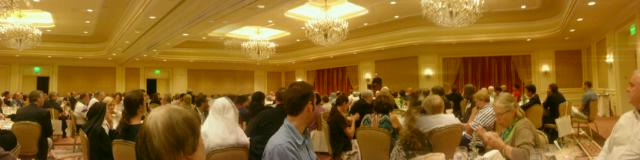
Opening dinner of the colloquium
For me it was a week I cannot match to any in memory. It
seemed to be that for most participants, although, of course, I didn’t meet
every one of the more than 200 people there.
General observations are: People from all over the country
and, indeed, all over the world, came together in a bonding I have never
experienced before. They sang – in the form of more than a half dozen choirs –
chant and sacred polyphony for six different Masses, four in the Ordinary Form
and two in the Extraordinary Form. They did this by practicing what would be
sung that day and came up with amazing results.
We had, of course, some excellent teachers and directors. I
can speak best to the men’s chant schola, in which I was the only woman. I had
been assured by organizers that they always had three or four women in the
men’s groups, and some counter-tenor men in the women’s groups, but I was the
only female with 39 men, four or five of them priests. There were, I am told,
two or three men with the women’s schola, but I never saw them.
There were three chant levels: beginners; those who needed
some refresher work; and the scholas. This made six groups divided by male and
female voices. Between them, they did all the chant propers for the Masses,
while polyphony groups did some “part” propers. Some days the ordinaries were
sung in chant, some days in polyphony. For the chant ordinaries, no one even
practiced (except perhaps for the beginners); it was assumed we all knew them
well enough to sing them “cold”. And it turned out fine.
In addition to singing practice and instruction, there were
lectures and presentations on church music documents, conducting, and numerous
other topics. If one had wished, one could have been busy from the 8:15 morning
prayer until 10pm, when some concerts and films concluded. Mass was at 5:15pm
on the weekdays, and at 11am on Saturday and Sunday.
If I have any criticism, it was that things were scheduled
too close together. Most of us stayed at a hotel two or three miles from
classes, taken in by bus each morning and back each afternoon. I had my own “chauffeur”,
but sometimes getting back and forth meant missing some things – for both the “chauffeur”
and for me. Finally we just decided to set priorities and forgot all the events
we couldn’t make.
The Cathedral itself was the site for many sessions, while
the choir school, up the steepest hill I have ever seen, was the place
everything else was held. That often meant scurrying from a practice in the
school to the cathedral with only 15 minutes until Mass. It all worked out, but
there were a few anxious moments. The celebrants never started until we were
all in place, however.
Due to hard work and a lot of talent, the Masses were
glorious. The chaplain for CMAA, Father Paisley, was very well trained in
singing and the EF form. He is pastor of a parish in New Jersey, which is the
only diocesan parish in the country dedicated to the older form of Mass.
Our director was Jeffrey Morse, who is choirmaster for St.
Stephen’s Church in Sacramento, CA. He has a choir of 25-30 and a small group
of young choristers. He was very disciplined in his approach, but very amusing
also. He studied under Mary Berry, a nun whom I had the privilege of hearing at
Marylhurst (a former college of the Holy Name nuns in Oregon) during a chant
workshop 30 years. It was only recently I discovered how important his woman
was to sacred music. During a time when things were falling apart musically in
both Europe and the United States, she often left her post as a don at
Cambridge University and went around the world to carry the message of chant in
the liturgy. She died in 2007 at the age of 91. Jeffrey told us her history,
which included the fact that she had to be exclaustrated (released from convent
life) to teach at Cambridge, and was never again allowed to use her religious
name of Sister Thomas More. She fled the Nazis during World War II and her
story is amazing.
Without getting too technical, Jeffrey initiated us into
some 9th -century chant interpretations to use with the notation
that Solesmes reformed in the last century. Often, just rehearsing took a lot
of time, as we had some difficult things to do. However, the men I was with
were very skilled, and after one day, it was hard to tell none of us had ever
sung together before.
Lunches outside – sometimes in nearly 100-degree heat –
allowed some of us to come back together and talk. Universally there was a
sense of happiness and peace I have never seen in such a large group. We also
had two dinners at which we eagerly shared thoughts with other attendees. I met
at least five people with whom I intend to continue a relationship, including a
woman from Michigan with nine children, who is pretty much carrying her parish
musically. We (along with her mom) became almost instant friends. There were others,
especially two priests with whom I really had some good discussions.
The Mass on Wednesday was a solemn high requiem in the
extraordinary form, said for all deceased members of the CMAA, including Msgr.
Schuler, who started all this. It was incredibly beautiful, especially the
sequence, Dies Irae, sung alternately
by men and woman. Although our schola has practiced that Mass, I hadn’t sung it
at an actual liturgy in more than 50 years. The parishioners who attended
seemed stunned by the beauty of the music.
The Cathedral is also beautiful, but has had some
regrettable renovations, such as removal of the side altars. This meant that
the priests there had no place to say their own Masses, but some did concelebrate
at the OF liturgies. Since that is not done in EF Masses, though, they had to
say Mass in their hotel rooms for the most part.
The cathedral also has a large of choir stalls, normally
used as overflow seating, but which was perfect for our purposes. We could the
face the women’s schola and alternate the way it should be done. The frescoes
on walls are wonderful and the stained glass windows and marble breathtaking.
The acoustics are very good, also. We never got a visit from the bishop, but I
guess he was occupied elsewhere.
The hotel, Little America, was palatial. For a reduced fee
of $69 per night, we got suites that were almost the size of a small condo. The
staff bent over backwards to assist us and I never had to open a door myself.
We had the formal meals there and the food was wonderful.
In addition to the music practicums, we had lectures we
could take in each morning and afternoon and also an hour talk from some of the
presenters before Mass each weekday. Also, I should mention the Madeleine Choir School. It
is a day school for young people who have talent and the desire to sing good
sacred music. The director is fabulous. We got a concert on Tuesday night with
fourteen selections of the most glorious polyphony and hymns I have ever heard
in one place. Only Salt Lake City and Boston have such a school, although the
Lyceum Catholic School in Ohio has a wonderful schola of young people as well.
On Saturday, we did only practices and the Mass was in the morning.
Then we had solemn polyphonic Vespers at 3pm that almost brought us to tears;
it was glorious. We were then free to pursue our own activities that evening.
On Sunday, we sang at the regular 11am Mass of the parish.
That was full to overflowing, and a polyphonic Mass by Monteverdi made it long
but very moving. After Mass we had a brunch and final words from the
Association board members. Although this was the 22nd colloquium of
the CMAA, the organizers were so impressed with the facilities, they want to
come back to SLC next year or as soon as possible, but that had not been worked
out yet.
Here's the trailer of a video on the Madeleine Choir School:
Sunday, July 1, was the Big Day: Bishop Cary, ordained bishop of the Diocese of Baker on May 18, 2012, made his first visit to St. Francis de Sales Cathedral in Baker City, Oregon!
The Mass was preceded by Bishop Cary knocking on the door of the Cathedral and being received by Fr. Julian Cassar, the rector. In his opening remarks, Bishop Cary said that he was “taking possession of the bishop’s chair, which represents the diocese”.
Bishop Cary knocks on the door.
Fr. Julian Cassar opens the door.
At the homily, Bishop Cary began by introducing himself and noting that the last six weeks have been, for him, “days of becoming a bishop”, and noted that it is “quite a change”. Our prayers must be with him on a daily basis!
Bishop Cary also mentioned that he has an affinity for St. Francis de Sales, who is the patron saint of the Diocese, and of the Cathedral which is named after him.
Bishop Cary with St. Francis de Sales
For the actual homily, Bishop Cary drew a parallel between the Gospel account of Jairus and his daughter and the Fortnight for Freedom concerning Obamacare and the HHS mandate.
First he noted that to become a bishop in 2012 was to step into the campaign to protect religious freedom. In today's gospel, Jesus, said the bishop, was also in a campaign – he was marching to do battle with death as he made his way to the house of Jairus, with a large crowd following in procession. Along the way, Jesus performed some healing acts for those battling illness. “To be a Christian is to step into that procession to battle death,” said Bishop Cary
Of course, the real battle with death was ultimately on the Cross, said the bishop, and what seemed to be a defeat was in fact a victory.
Bishop Cary went on to say that religious liberty is currently at stake. The HHS mandate “requires Catholics to ignore the teaching of the Church,” he said. “The Church must publicly go against its own teaching and surrender to the moral decisions of the State.
“The government bureaucracy – the HHS – tells us who we are and can be as Catholics,” he added, “by their definition of ‘religious institution’. We cease to be Catholics if we employ or serve more non-Catholics than Catholics.
“We used to ask ‘Are you hungry?’ or ‘Are you sick?’ Now we have to ask ‘Are you Catholic?’ We do these things – feed the hungry and take care of the sick – because we are Catholics…not because they are.”
The bishop also noted that “religious liberty is not a right the government gives us; it is a right the government owes us because it comes from God Himself.” He concluded by encouraging all to deepen our resolve to take steps to make sure that this same freedom is handed on to those who come after us.
Here are a few more photos:
The miter and crosier bearer
were vested in vimpae.
It is really a lovely Cathedral.
The cathedral wasn't packed, but there was a sizeable crowd.
 Grant that my soul may hunger after Thee, the bread of angels, the refreshment of holy